Metabolic-Epigenetic Reprogramming in Cancer: Cell-State Plasticity, Tumor Microenvironment, and Therapeutic Opportunities
DOI:
https://doi.org/10.66505/cbtt.v1i4.56Keywords:
Metabolic reprogramming, cancer epigenetics, metabolic–epigenetic crosstalk, oncometabolites, cell-state plasticity, tumor microenvironment, therapeutic resistance, targeted therapyAbstract
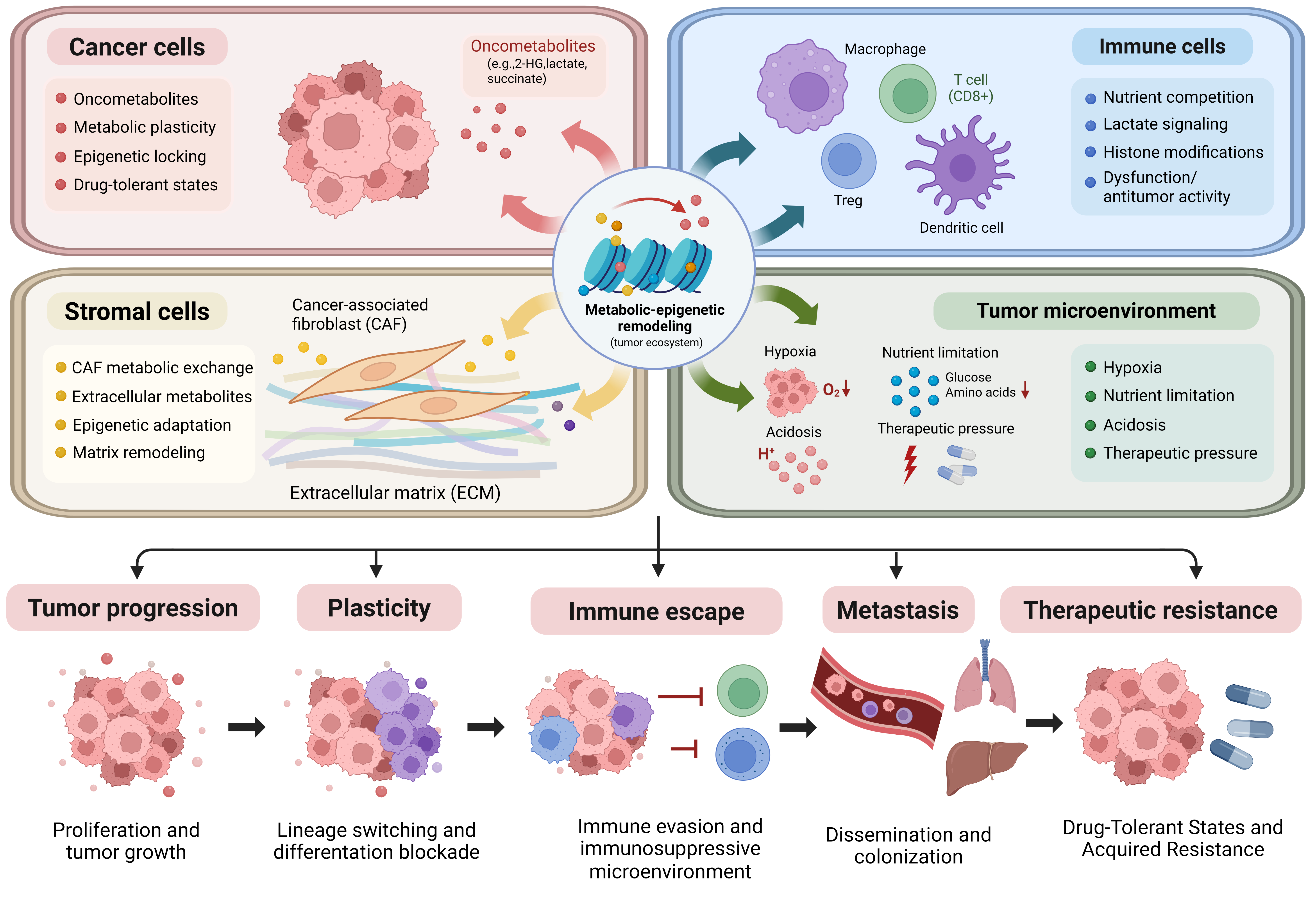
Changes in metabolism and chromatin regulation help cancer cells sustain proliferation under nutrient limitation and adapt to therapy. Acetyl-CoA and S-adenosylmethionine donate acetyl and methyl groups for histone acetylation and methylation, respectively. Other chromatin-modifying reactions require α-ketoglutarate or NAD⁺, and lactate metabolism contributes to histone lactylation. Regulation also runs in the opposite direction. DNA methylation, histone modifications, chromatin remodeling, and noncoding RNAs influence metabolic pathway use by altering expression of enzymes and transporters. These reciprocal effects can stabilize malignant cell states or alter lineage identity and substrate use, with consequences for antitumor immunity, metastatic adaptation, and drug tolerance. Accumulation of 2-hydroxyglutarate, succinate, or fumarate illustrates how metabolic perturbations can directly affect chromatin regulation and cell fate. Studies outside cancer show that some chromatin changes persist after the initiating metabolic stimulus ends. In residual disease, the question is whether cells that retain these changes after drug withdrawal respond differently to subsequent treatment than cells whose chromatin state returns to baseline. The distinction matters because a state maintained after withdrawal may present a different therapeutic target from one that requires continued drug exposure. This review examines how metabolic flux influences chromatin and how the resulting transcriptional changes shape cell states within the tumor microenvironment. We discuss clinical evidence for mutant IDH inhibition and consider investigational combinations that target metabolic and epigenetic regulators. We also examine how isotope tracing, single-cell and spatial multi-omics, and serial biomarker measurements can identify therapeutic dependencies, inform patient selection, and monitor emerging resistance.
References
1. Li X, Yu W, Qian X, Xia Y, Zheng Y, Lee JH, et al. Nucleus-translocated ACSS2 promotes gene transcription for lysosomal biogenesis and autophagy. Mol Cell. 2017;66(5):684-697.e9. doi:10.1016/j.molcel.2017.04.026
2. Cai L, Sutter BM, Li B, Tu BP. Acetyl-CoA induces cell growth and proliferation by promoting the acetylation of histones at growth genes. Mol Cell. 2011;42(4):426-437. doi:10.1016/j.molcel.2011.05.004
3. Lu C, Ward PS, Kapoor GS, Rohle D, Turcan S, Abdel-Wahab O, et al. IDH mutation impairs histone demethylation and results in a block to cell differentiation. Nature. 2012;483(7390):474-478. doi:10.1038/nature10860
4. Kaelin WG Jr, McKnight SL. Influence of metabolism on epigenetics and disease. Cell. 2013;153(1):56-69. doi:10.1016/j.cell.2013.03.004
5. Zhong L, D’Urso A, Toiber D, Sebastian C, Henry RE, Vadysirisack DD, et al. The histone deacetylase Sirt6 regulates glucose homeostasis via Hif1alpha. Cell. 2010;140(2):280-293. doi:10.1016/j.cell.2009.12.041
6. DeBerardinis RJ, Thompson CB. Cellular metabolism and disease: what do metabolic outliers teach us? Cell. 2012;148(6):1132-1144. doi:10.1016/j.cell.2012.02.032
7. Zhang YW, Schönberger K, Cabezas-Wallscheid N. Bidirectional interplay between metabolism and epigenetics in hematopoietic stem cells and leukemia. EMBO J. 2023;42(24):e112348. doi:10.15252/embj.2022112348
8. Tischler J, Gruhn WH, Reid J, Allgeyer E, Buettner F, Marr C, et al. Metabolic regulation of pluripotency and germ cell fate through α-ketoglutarate. EMBO J. 2019;38(1):e99518. doi:10.15252/embj.201899518
9. Zhou W, Zhao T, Du J, Ji G, Li X, Ji S, et al. TIGAR promotes neural stem cell differentiation through acetyl-CoA-mediated histone acetylation. Cell Death Dis. 2019;10(3):198. doi:10.1038/s41419-019-1434-3
10. Yu X, Wu H, Su J, Liu X, Liang K, Li Q, et al. Acetyl-CoA metabolism maintains histone acetylation for syncytialization of human placental trophoblast stem cells. Cell Stem Cell. 2024;31(9):1280-1297.e7. doi:10.1016/j.stem.2024.07.003
11. Hsieh WC, Sutter BM, Ruess H, Barnes SD, Malladi VS, Tu BP. Glucose starvation induces a switch in the histone acetylome for activation of gluconeogenic and fat metabolism genes. Mol Cell. 2022;82(1):60-74.e5. doi:10.1016/j.molcel.2021.12.015
12. Xu X, Peng Q, Jiang X, Tan S, Yang Y, Yang W, et al. Metabolic reprogramming and epigenetic modifications in cancer: from the impacts and mechanisms to the treatment potential. Exp Mol Med. 2023;55(7):1357-1370. doi:10.1038/s12276-023-01020-1
13. Waldschmidt JM, Kloeber JA, Anand P, Frede J, Kokkalis A, Dimitrova V, et al. Single-cell profiling reveals metabolic reprogramming as a resistance mechanism in BRAF-mutated multiple myeloma. Clin Cancer Res. 2021;27(23):6432-6444. doi:10.1158/1078-0432.CCR-21-2040
14. Baylin SB, Jones PA. A decade of exploring the cancer epigenome - biological and translational implications. Nat Rev Cancer. 2011;11(10):726-734. doi:10.1038/nrc3130
15. Ling C, Bacos K, Rönn T. Epigenetics of type 2 diabetes mellitus and weight change - a tool for precision medicine? Nat Rev Endocrinol. 2022;18(7):433-448. doi:10.1038/s41574-022-00671-w
16. Baeken MW, Borlepawar A, Kötzner P, Richly H, Behl C, Moosmann B, et al. Epigenetic regulation of the respiratory chain by a mitochondrial distress-related redox signal. Front Cell Dev Biol. 2025;13:1608400. doi:10.3389/fcell.2025.1608400
17. Belk JA, Daniel B, Satpathy AT. Epigenetic regulation of T cell exhaustion. Nat Immunol. 2022;23(6):848-860. doi:10.1038/s41590-022-01224-z
18. Montano EN, Bose M, Huo L, Tumurkhuu G, De Los Santos G, Simental B, et al. α-Ketoglutarate-dependent KDM6 histone demethylases and interferon-stimulated gene expression in lupus. Arthritis Rheumatol. 2024;76(3):396-410. doi:10.1002/art.42724
19. Zhang C, Meng Y, Han J. Emerging roles of mitochondrial functions and epigenetic changes in the modulation of stem cell fate. Cell Mol Life Sci. 2024;81(1):26. doi:10.1007/s00018-023-05070-6
20. Mao X, Xia D, Xu M, Gao Y, Tong L, Lu C, et al. Single-cell simultaneous metabolome and transcriptome profiling revealing metabolite-gene correlation network. Adv Sci (Weinh). 2025;12(4):e2411276. doi:10.1002/advs.202411276
21. Haws SA, Leech CM, Denu JM. Metabolism and the epigenome: a dynamic relationship. Trends Biochem Sci. 2020;45(9):731-747. doi:10.1016/j.tibs.2020.04.002
22. Martínez-Reyes I, Chandel NS. Mitochondrial TCA cycle metabolites control physiology and disease. Nat Commun. 2020;11(1):102. doi:10.1038/s41467-019-13668-3
23. Dai Z, Mentch SJ, Gao X, Nichenametla SN, Locasale JW. Methionine metabolism influences genomic architecture and gene expression through H3K4me3 peak width. Nat Commun. 2018;9(1):1955. doi:10.1038/s41467-018-04426-y
24. Wellen KE, Hatzivassiliou G, Sachdeva UM, Bui TV, Cross JR, Thompson CB. ATP-citrate lyase links cellular metabolism to histone acetylation. Science. 2009;324(5930):1076-1080. doi:10.1126/science.1164097
25. Mentch SJ, Mehrmohamadi M, Huang L, Liu X, Gupta D, Mattocks D, et al. Histone methylation dynamics and gene regulation occur through the sensing of one-carbon metabolism. Cell Metab. 2015;22(5):861-873. doi:10.1016/j.cmet.2015.08.024
26. Tran KA, Dillingham CM, Sridharan R. The role of α-ketoglutarate-dependent proteins in pluripotency acquisition and maintenance. J Biol Chem. 2019;294(14):5408-5419. doi:10.1074/jbc.TM118.000831
27. Imai S, Armstrong CM, Kaeberlein M, Guarente L. Transcriptional silencing and longevity protein Sir2 is an NAD-dependent histone deacetylase. Nature. 2000;403(6771):795-800. doi:10.1038/35001622
28. Etchegaray JP, Zhong L, Li C, Henriques T, Ablondi E, Nakadai T, et al. The histone deacetylase SIRT6 restrains transcription elongation via promoter-proximal pausing. Mol Cell. 2019;75(4):683-699.e7. doi:10.1016/j.molcel.2019.06.034
29. Baksh SC, Finley LWS. Metabolic coordination of cell fate by α-ketoglutarate-dependent dioxygenases. Trends Cell Biol. 2021;31(1):24-36. doi:10.1016/j.tcb.2020.09.010
30. Lanzetti L. Oncometabolites at the crossroads of genetic, epigenetic and ecological alterations in cancer. Cell Death Differ. 2024;31(12):1582-1594. doi:10.1038/s41418-024-01402-6
31. Pirozzi CJ, Yan H. The implications of IDH mutations for cancer development and therapy. Nat Rev Clin Oncol. 2021;18(10):645-661. doi:10.1038/s41571-021-00521-0
32. Sciacovelli M, Gonçalves E, Johnson TI, Zecchini VR, Henriques da Costa AS, Gaude E, et al. Fumarate is an epigenetic modifier that elicits epithelial-to-mesenchymal transition. Nature. 2016;537(7621):544-547. doi:10.1038/nature19353
33. Kusi M, Zand M, Lin LL, Chen M, Lopez A, Lin CL, et al. 2-Hydroxyglutarate destabilizes chromatin regulatory landscape and lineage fidelity to promote cellular heterogeneity. Cell Rep. 2022;38(2):110220. doi:10.1016/j.celrep.2021.110220
34. Carey BW, Finley LWS, Cross JR, Allis CD, Thompson CB. Intracellular α-ketoglutarate maintains the pluripotency of embryonic stem cells. Nature. 2015;518(7539):413-416. doi:10.1038/nature13981
35. Chandel NS, Maltepe E, Goldwasser E, Mathieu CE, Simon MC, Schumacker PT. Mitochondrial reactive oxygen species trigger hypoxia-induced transcription. Proc Natl Acad Sci U S A. 1998;95(20):11715-11720. doi:10.1073/pnas.95.20.11715
36. Schvartzman JM, Reuter VP, Koche RP, Thompson CB. 2-Hydroxyglutarate inhibits MyoD-mediated differentiation by preventing H3K9 demethylation. Proc Natl Acad Sci U S A. 2019;116(26):12851-12856. doi:10.1073/pnas.1817662116
37. Morris JP 4th, Yashinskie JJ, Koche R, Chandwani R, Tian S, Chen CC, et al. α-Ketoglutarate links p53 to cell fate during tumour suppression. Nature. 2019;573(7775):595-599. doi:10.1038/s41586-019-1577-5
38. Zhang D, Tang Z, Huang H, Zhou G, Cui C, Weng Y, et al. Metabolic regulation of gene expression by histone lactylation. Nature. 2019;574(7779):575-580. doi:10.1038/s41586-019-1678-1
39. Hu Y, He Z, Li Z, Wang Y, Wu N, Sun H, et al. Lactylation: the novel histone modification influence on gene expression, protein function, and disease. Clin Epigenetics. 2024;16(1):72. doi:10.1186/s13148-024-01682-2
40. Zhang F, Zhou J, Lu P, Zhang X, Yang L, Wu J, et al. Lactylation of histone by BRD4 regulates astrocyte polarization after experimental subarachnoid hemorrhage. J Neuroinflammation. 2024;21(1):186. doi:10.1186/s12974-024-03185-6
41. Zhao Y, Zhang M, Huang X, Liu J, Sun Y, Zhang F, et al. Lactate modulates zygotic genome activation through H3K18 lactylation rather than H3K27 acetylation. Cell Mol Life Sci. 2024;81(1):298. doi:10.1007/s00018-024-05349-2
42. Sun L, Zhang H, Gao P. Metabolic reprogramming and epigenetic modifications on the path to cancer. Protein Cell. 2022;13(12):877-919. doi:10.1007/s13238-021-00846-7
43. Gao W, Liu JL, Lu X, Yang Q. Epigenetic regulation of energy metabolism in obesity. J Mol Cell Biol. 2021;13(7):480-499. doi:10.1093/jmcb/mjab043
44. Yucel N, Wang YX, Mai T, Porpiglia E, Lund PJ, Markov G, et al. Glucose metabolism drives histone acetylation landscape transitions that dictate muscle stem cell function. Cell Rep. 2019;27(13):3939-3955.e6. doi:10.1016/j.celrep.2019.05.092
45. Wang G, Han JJ. Connections between metabolism and epigenetic modifications in cancer. Med Rev (2021). 2021;1(2):199-221. doi:10.1515/mr-2021-0015
46. King SE, Skinner MK. Epigenetic transgenerational inheritance of obesity susceptibility. Trends Endocrinol Metab. 2020;31(7):478-494. doi:10.1016/j.tem.2020.02.009
47. Ling C, Rönn T. Epigenetics in human obesity and type 2 diabetes. Cell Metab. 2019;29(5):1028-1044. doi:10.1016/j.cmet.2019.03.009
48. Morrison AJ. Chromatin-remodeling links metabolic signaling to gene expression. Mol Metab. 2020;38:100973. doi:10.1016/j.molmet.2020.100973
49. Cheng SC, Quintin J, Cramer RA, Shepardson KM, Saeed S, Kumar V, et al. mTOR- and HIF-1α-mediated aerobic glycolysis as metabolic basis for trained immunity. Science. 2014;345(6204):1250684. doi:10.1126/science.1250684
50. Tyrakis PA, Palazon A, Macias D, Lee KL, Phan AT, Veliça P, et al. S-2-hydroxyglutarate regulates CD8+ T-lymphocyte fate. Nature. 2016;540(7632):236-241. doi:10.1038/nature20165
51. Gomez-Alonso MDC, Kretschmer A, Wilson R, Pfeiffer L, Karhunen V, Seppälä I, et al. DNA methylation and lipid metabolism: an EWAS of 226 metabolic measures. Clin Epigenetics. 2021;13(1):7. doi:10.1186/s13148-020-00957-8
52. Tu C, Qian C, Li S, Lin DY, Liu ZY, Ouyang WG, et al. Targeting the chromatin remodeler BAZ2B mitigates hepatic senescence and MASH fibrosis. Nat Aging. 2025;5(6):1063-1078. doi:10.1038/s43587-025-00862-w
53. Markert J, Luger K. Nucleosomes meet their remodeler match. Trends Biochem Sci. 2021;46(1):41-50. doi:10.1016/j.tibs.2020.08.010
54. Li S, Peng M, Tan S, Oyang L, Lin J, Xia L, et al. The roles and molecular mechanisms of non-coding RNA in cancer metabolic reprogramming. Cancer Cell Int. 2024;24(1):37. doi:10.1186/s12935-023-03186-0
55. Murri M, El Azzouzi H. MicroRNAs as regulators of mitochondrial dysfunction and obesity. Am J Physiol Heart Circ Physiol. 2018;315(2):H291-H302. doi:10.1152/ajpheart.00691.2017
56. Wang K, Lu Y, Li H, Zhang J, Ju Y, Ouyang M. Role of long non-coding RNAs in metabolic reprogramming of gastrointestinal cancer cells. Cancer Cell Int. 2024;24(1):15. doi:10.1186/s12935-023-03194-0
57. Hsu CY, Faisal A, Jumaa SS, Gilmanova NS, Ubaid M, Athab AH, et al. Exploring the impact of circRNAs on cancer glycolysis: insights into tumor progression and therapeutic strategies. Noncoding RNA Res. 2024;9(3):970-994. doi:10.1016/j.ncrna.2024.05.001
58. Weintraub AS, Li CH, Zamudio AV, Sigova AA, Hannett NM, Day DS, et al. YY1 is a structural regulator of enhancer-promoter loops. Cell. 2017;171(7):1573-1588.e28. doi:10.1016/j.cell.2017.11.008
59. Su R, Zhou M, Lin J, Shan G, Huang C. A circular RNA-gawky-chromatin regulatory axis modulates stress-induced transcription. Nucleic Acids Res. 2024;52(7):3702-3721. doi:10.1093/nar/gkae157
60. Sahu V, Lu C. Metabolism-driven chromatin dynamics: molecular principles and technological advances. Mol Cell. 2025;85(2):262-275. doi:10.1016/j.molcel.2024.12.012
61. Gantner BN, Palma FR, Pandkar MR, Sakiyama MJ, Arango D, DeNicola GM, et al. Metabolism and epigenetics: drivers of tumor cell plasticity and treatment outcomes. Trends Cancer. 2024;10(11):992-1008. doi:10.1016/j.trecan.2024.08.005
62. Vander Heiden MG, Cantley LC, Thompson CB. Understanding the Warburg effect: the metabolic requirements of cell proliferation. Science. 2009;324(5930):1029-1033. doi:10.1126/science.1160809
63. Sutendra G, Kinnaird A, Dromparis P, Paulin R, Stenson TH, Haromy A, et al. A nuclear pyruvate dehydrogenase complex is important for the generation of acetyl-CoA and histone acetylation. Cell. 2014;158(1):84-97. doi:10.1016/j.cell.2014.04.046
64. Wang Z, Yip LY, Lee JHJ, Wu Z, Chew HY, Chong PKW, et al. Methionine is a metabolic dependency of tumor-initiating cells. Nat Med. 2019;25(5):825-837. doi:10.1038/s41591-019-0423-5
65. Ippolito L, Comito G, Parri M, Iozzo M, Duatti A, Virgilio F, et al. Lactate rewires lipid metabolism and sustains a metabolic-epigenetic axis in prostate cancer. Cancer Res. 2022;82(7):1267-1282. doi:10.1158/0008-5472.CAN-21-0914
66. Tran TQ, Hanse EA, Habowski AN, Li H, Ishak Gabra MB, Yang Y, et al. α-Ketoglutarate attenuates Wnt signaling and drives differentiation in colorectal cancer. Nat Cancer. 2020;1(3):345-358. doi:10.1038/s43018-020-0035-5
67. Young CM, Beziaud L, Dessen P, Madurga Alonso A, Santamaria-Martínez A, Huelsken J. Metabolic dependencies of metastasis-initiating cells in female breast cancer. Nat Commun. 2023;14(1):7076. doi:10.1038/s41467-023-42748-8
68. Xiao M, Yang H, Xu W, Ma S, Lin H, Zhu H, et al. Inhibition of α-KG-dependent histone and DNA demethylases by fumarate and succinate that are accumulated in mutations of FH and SDH tumor suppressors. Genes Dev. 2012;26(12):1326-1338. doi:10.1101/gad.191056.112
69. Chłopek M, Lasota J, Singh O, Blakely AM, Glod J, Ylaya K, et al. DNA methylation profiling separates SDH-deficient GISTs from KIT-PDGFRA-driven GISTs and identifies predictive biomarkers for targeted therapy. Am J Surg Pathol. 2025;49(11):1105-1113. doi:10.1097/PAS.0000000000002444
70. Yoo A, Tang C, Zucker M, Fitzgerald K, DiNatale RG, Rappold PM, et al. Genomic and metabolic hallmarks of SDH- and FH-deficient renal cell carcinomas. Eur Urol Focus. 2022;8(5):1278-1288. doi:10.1016/j.euf.2021.12.002
71. Qian H, Zhu M, Tan X, Zhang Y, Liu X, Yang L. Super-enhancers and the super-enhancer reader BRD4: tumorigenic factors and therapeutic targets. Cell Death Discov. 2023;9(1):470. doi:10.1038/s41420-023-01775-6
72. Yao W, Shang L, Wang Y, Xu L, Bai Y, Feng M, et al. DNMT1-driven methylation of RORA facilitates esophageal squamous cell carcinoma progression under hypoxia through SLC2A3. J Transl Med. 2024;22(1):1167. doi:10.1186/s12967-024-05960-8
73. Perlman BS, Burget N, Zhou Y, Schwartz GW, Petrovic J, Modrusan Z, et al. Enhancer-promoter hubs organize transcriptional networks promoting oncogenesis and drug resistance. Nat Commun. 2024;15(1):8070. doi:10.1038/s41467-024-52375-6
74. Chen JF, Yan Q. The roles of epigenetics in cancer progression and metastasis. Biochem J. 2021;478(17):3373-3393. doi:10.1042/BCJ20210084
75. Pierce SE, Granja JM, Corces MR, Brady JJ, Tsai MK, Pierce AB, et al. LKB1 inactivation modulates chromatin accessibility to drive metastatic progression. Nat Cell Biol. 2021;23(8):915-924. doi:10.1038/s41556-021-00728-4
76. Li S, Yang M, Teng S, Lin K, Wang Y, Zhang Y, et al. Chromatin accessibility dynamics in colorectal cancer liver metastasis: uncovering the liver tropism at single cell resolution. Pharmacol Res. 2023;195:106896. doi:10.1016/j.phrs.2023.106896
77. Dhanyamraju PK, Schell TD, Amin S, Robertson GP. Drug-tolerant persister cells in cancer therapy resistance. Cancer Res. 2022;82(14):2503-2514. doi:10.1158/0008-5472.CAN-21-3844
78. Rosano D, Sofyali E, Dhiman H, Ghirardi C, Ivanoiu D, Heide T, et al. Long-term multimodal recording reveals epigenetic adaptation routes in dormant breast cancer cells. Cancer Discov. 2024;14(5):866-889. doi:10.1158/2159-8290.CD-23-1161
79. McDonald PC, Dedhar S. Persister cell plasticity in tumour drug resistance. Semin Cell Dev Biol. 2024;156:1-10. doi:10.1016/j.semcdb.2023.11.003
80. Liotti A, Ferrara AL, Loffredo S, Galdiero MR, Varricchi G, Di Rella F, et al. Epigenetics: an opportunity to shape innate and adaptive immune responses. Immunology. 2022;167(4):451-470. doi:10.1111/imm.13571
81. Møller SH, Hsueh PC, Yu YR, Zhang L, Ho PC. Metabolic programs tailor T cell immunity in viral infection, cancer, and aging. Cell Metab. 2022;34(3):378-395. doi:10.1016/j.cmet.2022.02.003
82. Zhang Q, Cao X. Epigenetic remodeling in innate immunity and inflammation. Annu Rev Immunol. 2021;39:279-311. doi:10.1146/annurev-immunol-093019-123619
83. Saeed S, Quintin J, Kerstens HHD, Rao NA, Aghajanirefah A, Matarese F, et al. Epigenetic programming of monocyte-to-macrophage differentiation and trained innate immunity. Science. 2014;345(6204):1251086. doi:10.1126/science.1251086
84. Roy DG, Chen J, Mamane V, Ma EH, Muhire BM, Sheldon RD, et al. Methionine metabolism shapes T helper cell responses through regulation of epigenetic reprogramming. Cell Metab. 2020;31(2):250-266.e9. doi:10.1016/j.cmet.2020.01.006
85. O'Neill LAJ, Kishton RJ, Rathmell J. A guide to immunometabolism for immunologists. Nat Rev Immunol. 2016;16(9):553-565. doi:10.1038/nri.2016.70
86. Yang B, Kim S, Jung WJ, Kim K, Kim S, Kim YJ, et al. CTCF controls three-dimensional enhancer network underlying the inflammatory response of bone marrow-derived dendritic cells. Nat Commun. 2023;14(1):1277. doi:10.1038/s41467-023-36948-5
87. Mills TS, Kain B, Burchill MA, Danis E, Lucas ED, Culp-Hill R, et al. A distinct metabolic and epigenetic state drives trained immunity in HSC-derived macrophages from autoimmune mice. Cell Stem Cell. 2024;31(11):1630-1649.e8. doi:10.1016/j.stem.2024.09.010
88. Liu Q, Zhu F, Liu X, Lu Y, Yao K, Tian N, et al. Non-oxidative pentose phosphate pathway controls regulatory T cell function by integrating metabolism and epigenetics. Nat Metab. 2022;4(5):559-574. doi:10.1038/s42255-022-00575-z
89. Li Y, Cao Q, Hu Y, He B, Cao T, Tang Y, et al. Advances in the interaction of glycolytic reprogramming with lactylation. Biomed Pharmacother. 2024;177:116982. doi:10.1016/j.biopha.2024.116982
90. Yang Z, Yan C, Ma J, Peng P, Ren X, Cai S, et al. Lactylome analysis suggests lactylation-dependent mechanisms of metabolic adaptation in hepatocellular carcinoma. Nat Metab. 2023;5(1):61-79. doi:10.1038/s42255-022-00710-w
91. Arts RJW, Novakovic B, Ter Horst R, Carvalho A, Bekkering S, Lachmandas E, et al. Glutaminolysis and fumarate accumulation integrate immunometabolic and epigenetic programs in trained immunity. Cell Metab. 2016;24(6):807-819. doi:10.1016/j.cmet.2016.10.008
92. Bekkering S, Arts RJW, Novakovic B, Kourtzelis I, van der Heijden CDCC, Li Y, et al. Metabolic induction of trained immunity through the mevalonate pathway. Cell. 2018;172(1-2):135-146.e9. doi:10.1016/j.cell.2017.11.025
93. Havas KM, Milchevskaya V, Radic K, Alladin A, Kafkia E, Garcia M, et al. Metabolic shifts in residual breast cancer drive tumor recurrence. J Clin Invest. 2017;127(6):2091-2105. doi:10.1172/JCI89914
94. El-Osta A, Brasacchio D, Yao D, Pocai A, Jones PL, Roeder RG, et al. Transient high glucose causes persistent epigenetic changes and altered gene expression during subsequent normoglycemia. J Exp Med. 2008;205(10):2409-2417. doi:10.1084/jem.20081188
95. Barrès R, Osler ME, Yan J, Rune A, Fritz T, Caidahl K, et al. Non-CpG methylation of the PGC-1alpha promoter through DNMT3B controls mitochondrial density. Cell Metab. 2009;10(3):189-198. doi:10.1016/j.cmet.2009.07.011
96. Rönn T, Ofori JK, Perfilyev A, Hamilton A, Pircs K, Eichelmann F, et al. Genes with epigenetic alterations in human pancreatic islets impact mitochondrial function, insulin secretion, and type 2 diabetes. Nat Commun. 2023;14(1):8040. doi:10.1038/s41467-023-43719-9
97. Hinte LC, Castellano-Castillo D, Ghosh A, Melrose K, Gasser E, Noé F, et al. Adipose tissue retains an epigenetic memory of obesity after weight loss. Nature. 2024;636(8042):457-465. doi:10.1038/s41586-024-08165-7
98. Barbier-Torres L, Fortner KA, Iruzubieta P, Delgado TC, Giddings E, Chen Y, et al. Silencing hepatic MCJ attenuates non-alcoholic fatty liver disease (NAFLD) by increasing mitochondrial fatty acid oxidation. Nat Commun. 2020;11(1):3360. doi:10.1038/s41467-020-16991-2
99. Gerdts J, Brace EJ, Sasaki Y, DiAntonio A, Milbrandt J. SARM1 activation triggers axon degeneration locally via NAD⁺ destruction. Science. 2015;348(6233):453-457. doi:10.1126/science.1258366
100. Mews P, Donahue G, Drake AM, Luczak V, Abel T, Berger SL. Acetyl-CoA synthetase regulates histone acetylation and hippocampal memory. Nature. 2017;546(7658):381-386. doi:10.1038/nature22405
101. Haney MS, Pálovics R, Munson CN, Long C, Johansson PK, Yip O, et al. APOE4/4 is linked to damaging lipid droplets in Alzheimer's disease microglia. Nature. 2024;628(8006):154-161. doi:10.1038/s41586-024-07185-7
102. Mews P, Egervari G, Nativio R, Sidoli S, Donahue G, Lombroso SI, et al. Alcohol metabolism contributes to brain histone acetylation. Nature. 2019;574(7780):717-721. doi:10.1038/s41586-019-1700-7
103. Guan JS, Haggarty SJ, Giacometti E, Dannenberg JH, Joseph N, Gao J, et al. HDAC2 negatively regulates memory formation and synaptic plasticity. Nature. 2009;459(7243):55-60. doi:10.1038/nature07925
104. Gjoneska E, Pfenning AR, Mathys H, Quon G, Kundaje A, Tsai LH, et al. Conserved epigenomic signals in mice and humans reveal immune basis of Alzheimer's disease. Nature. 2015;518(7539):365-369. doi:10.1038/nature14252
105. Chang CH, Qiu J, O'Sullivan D, Buck MD, Noguchi T, Curtis JD, et al. Metabolic competition in the tumor microenvironment is a driver of cancer progression. Cell. 2015;162(6):1229-1241. doi:10.1016/j.cell.2015.08.016
106. Ho PC, Bihuniak JD, Macintyre AN, Staron M, Liu X, Amezquita R, et al. Phosphoenolpyruvate is a metabolic checkpoint of anti-tumor T cell responses. Cell. 2015;162(6):1217-1228. doi:10.1016/j.cell.2015.08.012
107. Sousa CM, Biancur DE, Wang X, Halbrook CJ, Sherman MH, Zhang L, et al. Pancreatic stellate cells support tumour metabolism through autophagic alanine secretion. Nature. 2016;536(7617):479-483. doi:10.1038/nature19084
108. Fiaschi T, Marini A, Giannoni E, Taddei ML, Gandellini P, De Donatis A, et al. Reciprocal metabolic reprogramming through lactate shuttle coordinately influences tumor-stroma interplay. Cancer Res. 2012;72(19):5130-5140. doi:10.1158/0008-5472.CAN-12-1949
109. Nieman KM, Kenny HA, Penicka CV, Ladanyi A, Buell-Gutbrod R, Zillhardt MR, et al. Adipocytes promote ovarian cancer metastasis and provide energy for rapid tumor growth. Nat Med. 2011;17(11):1498-1503. doi:10.1038/nm.2492
110. Bhagat TD, Von Ahrens D, Dawlaty M, Zou Y, Baddour J, Achreja A, et al. Lactate-mediated epigenetic reprogramming regulates formation of human pancreatic cancer-associated fibroblasts. ELife. 2019;8:e50663. doi:10.7554/eLife.50663
111. Charidemou E, Kirmizis A. A two-way relationship between histone acetylation and metabolism. Trends Biochem Sci. 2024;49(12):1046-1062. doi:10.1016/j.tibs.2024.10.005
112. Wang X, Wu X, Hong N, Jin W. Progress in single-cell multimodal sequencing and multi-omics data integration. Biophys Rev. 2024;16(1):13-28. doi:10.1007/s12551-023-01092-3
113. Chen C, Wang Z, Qin Y. Connections between metabolism and epigenetics: mechanisms and novel anti-cancer strategy. Front Pharmacol. 2022;13:935536. doi:10.3389/fphar.2022.935536
114. Suganuma T, Workman JL. Chromatin and metabolism. Annu Rev Biochem. 2018;87:27-49. doi:10.1146/annurev-biochem-062917-012634
115. Bulusu V, Tumanov S, Michalopoulou E, van den Broek NJ, MacKay G, Nixon C, et al. Acetate recapturing by nuclear acetyl-CoA synthetase 2 prevents loss of histone acetylation during oxygen and serum limitation. Cell Rep. 2017;18(3):647-658. doi:10.1016/j.celrep.2016.12.055
116. Li L, Shi L, Yang S, Yan R, Zhang D, Yang J, et al. SIRT7 is a histone desuccinylase that functionally links to chromatin compaction and genome stability. Nat Commun. 2016;7:12235. doi:10.1038/ncomms12235
117. Markouli M, Strepkos D, Papavassiliou KA, Papavassiliou AG, Piperi C. Crosstalk of epigenetic and metabolic signaling underpinning glioblastoma pathogenesis. Cancers (Basel). 2022;14(11):2655. doi:10.3390/cancers14112655
118. Wang L, Wu J, Sramek M, Obayomi SMB, Gao P, Li Y, et al. Heterogeneous enhancer states orchestrate β cell responses to metabolic stress. Nat Commun. 2024;15(1):9361. doi:10.1038/s41467-024-53717-0
119. Liu X, Peng T, Xu M, Lin S, Hu B, Chu T, et al. Spatial multi-omics: deciphering technological landscape of integration of multi-omics and its applications. J Hematol Oncol. 2024;17(1):72. doi:10.1186/s13045-024-01596-9
120. Li M, Thorne RF, Shi R, Zhang XD, Li J, Li J, et al. DDIT3 directs a dual mechanism to balance glycolysis and oxidative phosphorylation during glutamine deprivation. Adv Sci (Weinh). 2021;8(11):e2003732. doi:10.1002/advs.202003732
121. Perez LM, Venugopal SV, St Martin A, Freedland SJ, Di Vizio D, Freeman MR. Mechanisms governing lineage plasticity and metabolic reprogramming in cancer. Trends Cancer. 2024;10(11):1009-1022. doi:10.1016/j.trecan.2024.08.001
122. Yang D, Guo X, Xi R. The chromatin accessibility landscape in cell plasticity and reprogramming: understanding and overcoming the barriers. Bioessays. 2025;47(6):e70005. doi:10.1002/bies.70005
123. Dong P, Song L, Bendl J, Misir R, Shao Z, Edelstien J, et al. A multi-regional human brain atlas of chromatin accessibility and gene expression facilitates promoter-isoform resolution genetic fine-mapping. Nat Commun. 2024;15(1):10113. doi:10.1038/s41467-024-54448-y
124. Bravo González-Blas C, Matetovici I, Hillen H, Taskiran II, Vandepoel R, Christiaens V, et al. Single-cell spatial multi-omics and deep learning dissect enhancer-driven gene regulatory networks in liver zonation. Nat Cell Biol. 2024;26(1):153-167. doi:10.1038/s41556-023-01316-4
125. Tian FY, Marsit CJ. Environmentally induced epigenetic plasticity in development: epigenetic toxicity and epigenetic adaptation. Curr Epidemiol Rep. 2018;5(4):450-460. doi:10.1007/s40471-018-0175-7
126. Li H, Li D, Ledru N, Xuanyuan Q, Wu H, Asthana A, et al. Transcriptomic, epigenomic, and spatial metabolomic cell profiling redefines regional human kidney anatomy. Cell Metab. 2024;36(5):1105-1125.e10. doi:10.1016/j.cmet.2024.02.015
127. Niu Z, Chen C, Wang S, Lu C, Wu Z, Wang A, et al. HBO1 catalyzes lysine lactylation and mediates histone H3K9la to regulate gene transcription. Nat Commun. 2024;15(1):3561. doi:10.1038/s41467-024-47900-6
128. Tolu SS, Viny AD, Amengual JE, Pro B, Bates SE. Getting the right combination to break the epigenetic code. Nat Rev Clin Oncol. 2025;22(2):117-133. doi:10.1038/s41571-024-00972-1
129. Safari M, Scotto L, Basseville A, Litman T, Xue H, Petrukhin L, et al. Combined HDAC and eIF4A inhibition: a novel epigenetic therapy for pancreatic ductal adenocarcinoma. Drug Resist Updat. 2026;84:101312. doi:10.1016/j.drup.2025.101312
130. Gao Y, Zhang S, Zhang X, Du Y, Ni T, Hao S. Crosstalk between metabolic and epigenetic modifications during cell carcinogenesis. iScience. 2024;27(12):111359. doi:10.1016/j.isci.2024.111359
131. Nguyen TTT, Zhang Y, Shang E, Shu C, Torrini C, Zhao J, et al. HDAC inhibitors elicit metabolic reprogramming by targeting super-enhancers in glioblastoma models. J Clin Invest. 2020;130(7):3699-3716. doi:10.1172/JCI129049
132. Dang L, White DW, Gross S, Bennett BD, Bittinger MA, Driggers EM, et al. Cancer-associated IDH1 mutations produce 2-hydroxyglutarate. Nature. 2009;462(7274):739-744. doi:10.1038/nature08617
133. Stein EM, DiNardo CD, Pollyea DA, Fathi AT, Roboz GJ, Altman JK, et al. Enasidenib in mutant IDH2 relapsed or refractory acute myeloid leukemia. Blood. 2017;130(6):722-731. doi:10.1182/blood-2017-04-779405
134. DiNardo CD, Stein EM, de Botton S, Roboz GJ, Altman JK, Mims AS, et al. Durable remissions with ivosidenib in IDH1-mutated relapsed or refractory AML. N Engl J Med. 2018;378(25):2386-2398. doi:10.1056/NEJMoa1716984
135. Montesinos P, Recher C, Vives S, Zarzycka E, Wang J, Bertani G, et al. Ivosidenib and azacitidine in IDH1-mutated acute myeloid leukemia. N Engl J Med. 2022;386(16):1519-1531. doi:10.1056/NEJMoa2117344
136. Mellinghoff IK, van den Bent MJ, Blumenthal DT, Touat M, Peters KB, Clarke J, et al. Vorasidenib in IDH1- or IDH2-mutant low-grade glioma. N Engl J Med. 2023;389(7):589-601. doi:10.1056/NEJMoa2304194
137. Wang C, Huang W, Zhong Y, Zou X, Liu S, Li J, et al. Single-cell multi-modal chromatin profiles revealing epigenetic regulations of cells in hepatocellular carcinoma. Clin Transl Med. 2024;14(9):e70000. doi:10.1002/ctm2.70000
138. Buglakova E, Ekelöf M, Schwaiger-Haber M, Schlicker L, Molenaar MR, Shahraz M, et al. Spatial single-cell isotope tracing reveals heterogeneity of de novo fatty acid synthesis in cancer. Nat Metab. 2024;6(9):1695-1711. doi:10.1038/s42255-024-01118-4
139. Hu T, Allam M, Cai S, Henderson W, Yueh B, Garipcan A, et al. Single-cell spatial metabolomics with cell-type specific protein profiling for tissue systems biology. Nat Commun. 2023;14(1):8260. doi:10.1038/s41467-023-43917-5
140. Nunes JB, Ijsselsteijn ME, Abdelaal T, Ursem R, van der Ploeg M, Giera M, et al. Integration of mass cytometry and mass spectrometry imaging for spatially resolved single-cell metabolic profiling. Nat Methods. 2024;21(10):1796-1800. doi:10.1038/s41592-024-02392-6
141. Dang Q, Peng L, Niu Y, Pan X, Ye Z, Wang T, et al. Targeting ACSS2 disrupts metabolic-epigenetic crosstalk to restore apoptosis and temozolomide chemosensitivity in pancreatic neuroendocrine tumors. Cancer Lett. 2026;645:218406. doi:10.1016/j.canlet.2026.218406
142. Zhao Z, Jia W, Li Z, Shi S, Zhou J, Ning C, et al. Targeting the SIN1 mediated TTK/LDHA-H3K18la-GLUT3 axis disrupts metabolic-epigenetic crosstalk and suppresses progression in hyperglycolytic breast cancer. Cancer Lett. 2026;644:218328. doi:10.1016/j.canlet.2026.218328
143. Sharma SV, Lee DY, Li B, Quinlan MP, Takahashi F, Maheswaran S, et al. A chromatin-mediated reversible drug-tolerant state in cancer cell subpopulations. Cell. 2010;141(1):69-80. doi:10.1016/j.cell.2010.02.027
144. Mogol AN, Yoo JY, Eve AA, Goel M, Dutton DJ, Schane CP, et al. ACSS2-mediated metabolic-epigenetic crosstalk drives fulvestrant resistance and represents a novel therapeutic target. NPJ Breast Cancer. 2026;12(1):136. doi:10.1038/s41523-026-00987-0
Published
How to Cite
Issue
Section
License
Copyright (c) 2026 Piaoting Fu , Yiling Chen, Yusheng Lin, Hao Zhang, Lu Wang

This work is licensed under a Creative Commons Attribution 4.0 International License.
Copyright
Authors publishing in Cancer Biome and Targeted Therapy retain full copyright of their work. By submitting a manuscript, authors grant the publisher (GCINC Press) a non-exclusive license to publish, distribute, and archive the article, and to identify itself as the original publisher.
License
All articles are published open access under the terms of the Creative Commons Attribution 4.0 International License (CC BY 4.0).
https://creativecommons.org/licenses/by/4.0/. This license permits unrestricted use, distribution, reproduction, and adaptation in any medium, including for commercial purposes, provided that:
- Proper attribution is given to the original author(s) and source,
- A link to the license is provided, and
- Any changes made are clearly indicated.
Author Rights
Authors retain the right to:
- Use their article in future works (e.g., books, theses, lectures)
- Share and archive the final published version on institutional repositories or personal websites
- Adapt or translate their work, or authorize others to do so, with proper citation
Reuse by Third Parties
Content is licensed under the Creative Commons Attribution 4.0 International License (CC BY 4.0). Third parties may copy, redistribute, remix, transform, and build upon the material for any purpose, including commercial use, provided that appropriate credit is given to the original author(s).
Archiving and Preservation
All articles are made freely available immediately upon publication, without embargo. Cancer Biome and Targeted Therapy is hosted on the Open Journal Systems (OJS) platform, developed by the Public Knowledge Project (PKP). The journal participates in long-term digital preservation through the PKP Preservation Network (PKP PN) using the LOCKSS system. Authors are encouraged to self-archive in institutional repositories, disciplinary archives, and preprint servers in accordance with the license terms.




Funding data
-
National Natural Science Foundation of China
Grant numbers 82273183; 82572981; 82403413; 82472858 -
Natural Science Foundation of Guangdong Province
Grant numbers PZ2024-001 -
Basic and Applied Basic Research Foundation of Guangdong Province
Grant numbers 2025A1515012301; 2026A1515012806; 2024A1515012947