Targeting Human Telomerase in Cancer: Therapeutic Limitations and New Opportunities
DOI:
https://doi.org/10.66505/cbtt.v1i4.66Keywords:
Telomerase, telomere maintenance, telomerase reverse transcriptase (TERT), telomerase inhibitors, BIBR1532, structure-guided drug designAbstract
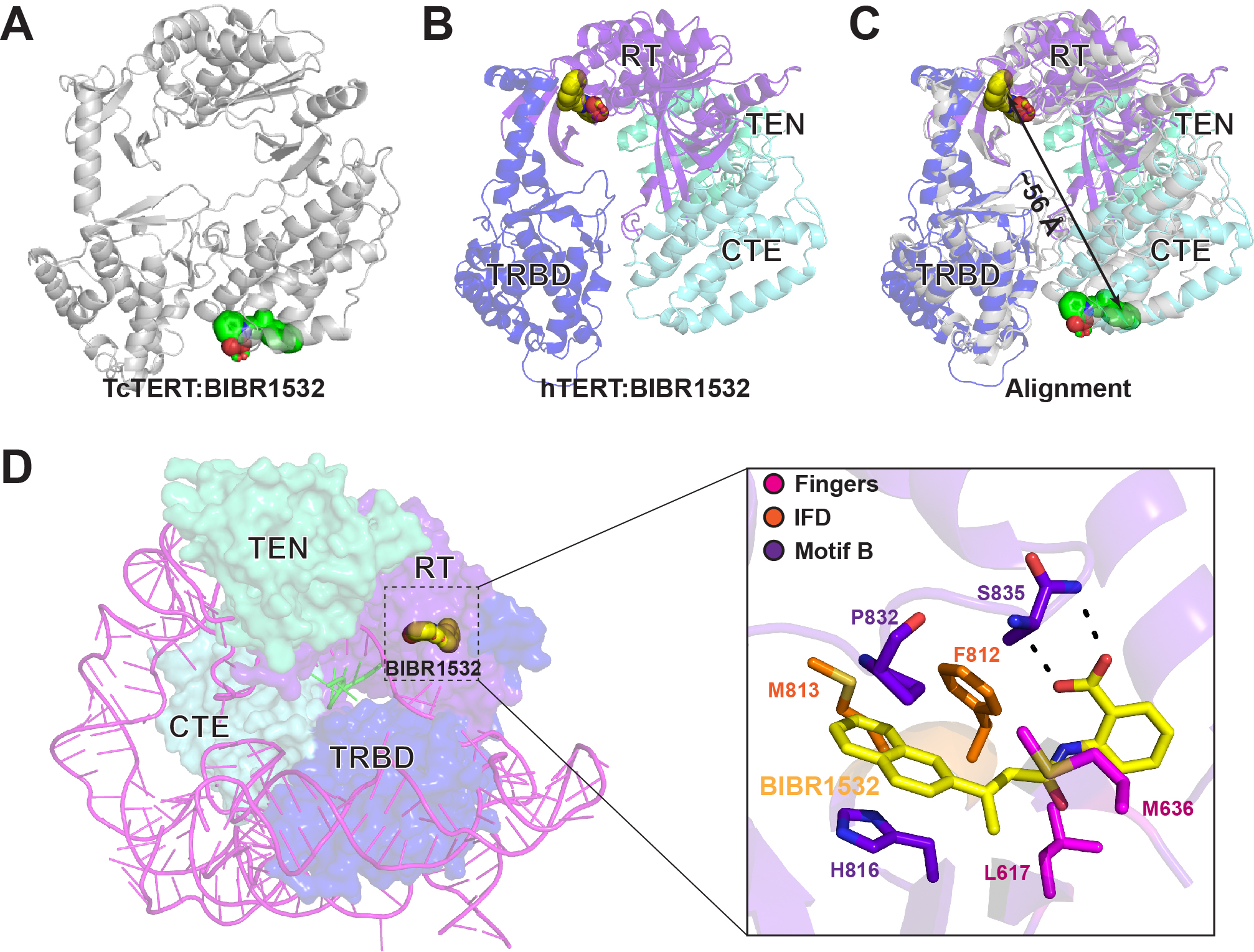
Telomerase reactivation sustains telomere maintenance in most human cancers, making the enzyme an attractive therapeutic target. However, the clinical development of telomerase inhibitors has been constrained by delayed responses, toxicity in normal proliferative tissues, and incomplete understanding of inhibitor binding to human telomerase. Structural studies of insect TERT-like proteins, ciliate and yeast holoenzymes, and human telomerase have clarified the organization of the catalytic machinery and the conformational changes required for telomeric repeat synthesis. A recent series of nine cryo-electron microscopy structures of human telomerase, with and without BIBR1532, identified an inhibitor-binding pocket between the TERT finger and palm regions. These structures revealed how BIBR1532 interferes with template-DNA duplex repositioning, providing a mechanistic explanation for its inhibition of repeat-addition processivity. Importantly, the human binding site differs substantially from the pocket previously identified in an insect TERT-like protein, illustrating the limitations of extrapolating inhibitor recognition across species. This Review integrates advances in telomerase structural biology with the therapeutic development of RNA-template antagonists, nucleotide analogs, and direct TERT inhibitors. We critically examine the translational limitations of these approaches, including the gap between biochemical inhibition and antitumor efficacy. Finally, we discuss how the newly characterized human TERT pocket could inform medicinal chemistry and computational drug design, while identifying the experimental and clinical evidence needed to establish its therapeutic potential.
References
1. Olovnikov AM. A theory of marginotomy. The incomplete copying of template margin in enzymic synthesis of polynucleotides and biological significance of the phenomenon. J Theor Biol. 1973;41(1):181-190. doi:10.1016/0022-5193(73)90198-7
2. Greider CW, Blackburn EH. Identification of a specific telomere terminal transferase activity in Tetrahymena extracts. Cell. 1985;43(2 Pt 1):405-413. doi:10.1016/0092-8674(85)90170-9
3. de Lange T. Shelterin-mediated telomere protection. Annu Rev Genet. 2018;52:223-247. doi:10.1146/annurev-genet-032918-021921
4. Shay JW, Wright WE. Telomeres and telomerase: three decades of progress. Nat Rev Genet. 2019;20(5):299-309. doi:10.1038/s41576-019-0099-1
5. Harley CB, Futcher AB, Greider CW. Telomeres shorten during ageing of human fibroblasts. Nature. 1990;345(6274):458-460. doi:10.1038/345458a0
6. Takai H, Aria V, Borges P, Yeeles JTP, de Lange T. CST-polymerase α-primase solves a second telomere end-replication problem. Nature. 2024;627(8004):664-670. doi:10.1038/s41586-024-07137-1
7. Chakravarti D, LaBella KA, DePinho RA. Telomeres: history, health, and hallmarks of aging. Cell. 2021;184(2):306-322. doi:10.1016/j.cell.2020.12.028
8. d'Adda di Fagagna F, Reaper PM, Clay-Farrace L, Fiegler H, Carr P, Von Zglinicki T, et al. A DNA damage checkpoint response in telomere-initiated senescence. Nature. 2003;426(6963):194-198. doi:10.1038/nature02118
9. Maciejowski J, Li Y, Bosco N, Campbell PJ, de Lange T. Chromothripsis and kataegis induced by telomere crisis. Cell. 2015;163(7):1641-1654. doi:10.1016/j.cell.2015.11.054
10. Roake CM, Artandi SE. Regulation of human telomerase in homeostasis and disease. Nat Rev Mol Cell Biol. 2020;21(7):384-397. doi:10.1038/s41580-020-0234-z
11. Schmidt JC, Cech TR. Human telomerase: biogenesis, trafficking, recruitment, and activation. Genes Dev. 2015;29(11):1095-1105. doi:10.1101/gad.263863.115
12. Barthel FP, Wei W, Tang M, Martinez-Ledesma E, Hu X, Amin SB, et al. Systematic analysis of telomere length and somatic alterations in 31 cancer types. Nat Genet. 2017;49(3):349-357. doi:10.1038/ng.3781
13. Sharma S, Chowdhury S. Emerging mechanisms of telomerase reactivation in cancer. Trends Cancer. 2022;8(8):632-641. doi:10.1016/j.trecan.2022.03.005
14. Kim NW, Piatyszek MA, Prowse KR, Harley CB, West MD, Ho PL, et al. Specific association of human telomerase activity with immortal cells and cancer. Science. 1994;266(5193):2011-2015. doi:10.1126/science.7605428
15. Horn S, Figl A, Rachakonda PS, Fischer C, Sucker A, Gast A, et al. TERT promoter mutations in familial and sporadic melanoma. Science. 2013;339(6122):959-961. doi:10.1126/science.1230062
16. Huang FW, Hodis E, Xu MJ, Kryukov GV, Chin L, Garraway LA. Highly recurrent TERT promoter mutations in human melanoma. Science. 2013;339(6122):957-959. doi:10.1126/science.1229259
17. Killela PJ, Reitman ZJ, Jiao Y, Bettegowda C, Agrawal N, Diaz LA Jr, et al. TERT promoter mutations occur frequently in gliomas and a subset of tumors derived from cells with low rates of self-renewal. Proc Natl Acad Sci U S A. 2013;110(15):6021-6026. doi:10.1073/pnas.1303607110
18. Bell RJ, Rube HT, Kreig A, Mancini A, Fouse SD, Nagarajan RP, et al. Cancer. The transcription factor GABP selectively binds and activates the mutant TERT promoter in cancer. Science. 2015;348(6238):1036-1039. doi:10.1126/science.aab0015
19. Hanahan D. Hallmarks of cancer: new dimensions. Cancer Discov. 2022;12(1):31-46. doi:10.1158/2159-8290.Cd-21-1059
20. Heaphy CM, Subhawong AP, Hong SM, Goggins MG, Montgomery EA, Gabrielson E, et al. Prevalence of the alternative lengthening of telomeres telomere maintenance mechanism in human cancer subtypes. Am J Pathol. 2011;179(4):1608-1615. doi:10.1016/j.ajpath.2011.06.018
21. He Y, Feigon J. Telomerase structural biology comes of age. Curr Opin Struct Biol. 2022;76:102446. doi:10.1016/j.sbi.2022.102446
22. Theimer CA, Blois CA, Feigon J. Structure of the human telomerase RNA pseudoknot reveals conserved tertiary interactions essential for function. Mol Cell. 2005;17(5):671-682. doi:10.1016/j.molcel.2005.01.017
23. Zhang Q, Kim NK, Feigon J. Architecture of human telomerase RNA. Proc Natl Acad Sci U S A. 2011;108(51):20325-20332. doi:10.1073/pnas.1100279108
24. Jurczyluk J, Nouwens AS, Holien JK, Adams TE, Lovrecz GO, Parker MW, et al. Direct involvement of the TEN domain at the active site of human telomerase. Nucleic Acids Res. 2011;39(5):1774-1788. doi:10.1093/nar/gkq1083
25. Theimer CA, Jády BE, Chim N, Richard P, Breece KE, Kiss T, et al. Structural and functional characterization of human telomerase RNA processing and Cajal body localization signals. Mol Cell. 2007;27(6):869-881. doi:10.1016/j.molcel.2007.07.017
26. Chen G, Wen JD, Tinoco I Jr. Single-molecule mechanical unfolding and folding of a pseudoknot in human telomerase RNA. RNA. 2007;13(12):2175-2188. doi:10.1261/rna.676707
27. Chen JL, Greider CW. Functional analysis of the pseudoknot structure in human telomerase RNA. Proc Natl Acad Sci U S A. 2005;102(23):8080-8085. doi:10.1073/pnas.0502259102
28. Gillis AJ, Schuller AP, Skordalakes E. Structure of the Tribolium castaneum telomerase catalytic subunit TERT. Nature. 2008;455(7213):633-637. doi:10.1038/nature07283
29. Mitchell M, Gillis A, Futahashi M, Fujiwara H, Skordalakes E. Structural basis for telomerase catalytic subunit TERT binding to RNA template and telomeric DNA. Nat Struct Mol Biol. 2010;17(4):513-518. doi:10.1038/nsmb.1777
30. Bryan C, Rice C, Hoffman H, Harkisheimer M, Sweeney M, Skordalakes E. Structural basis of telomerase inhibition by the highly specific BIBR1532. Structure. 2015;23(10):1934-1942. doi:10.1016/j.str.2015.08.006
31. Choi WS, Weng PJ, Yang W. Flexibility of telomerase in binding the RNA template and DNA telomeric repeat. Proc Natl Acad Sci U S A. 2022;119(1):e2116159118. doi:10.1073/pnas.2116159118
32. Wang Y, Gallagher-Jones M, Sušac L, Song H, Feigon J. A structurally conserved human and Tetrahymena telomerase catalytic core. Proc Natl Acad Sci U S A. 2020;117(49):31078-31087. doi:10.1073/pnas.2011684117
33. Jiang J, Miracco EJ, Hong K, Eckert B, Chan H, Cash DD, et al. The architecture of Tetrahymena telomerase holoenzyme. Nature. 2013;496(7444):187-192. doi:10.1038/nature12062
34. Jiang J, Chan H, Cash DD, Miracco EJ, Ogorzalek Loo RR, Upton HE, et al. Structure of Tetrahymena telomerase reveals previously unknown subunits, functions, and interactions. Science. 2015;350(6260):aab4070. doi:10.1126/science.aab4070
35. Jiang J, Wang Y, Sušac L, Chan H, Basu R, Zhou ZH, et al. Structure of telomerase with telomeric DNA. Cell. 2018;173(5):1179-1190.e13. doi:10.1016/j.cell.2018.04.038
36. He Y, Wang Y, Liu B, Helmling C, Sušac L, Cheng R, et al. Structures of telomerase at several steps of telomere repeat synthesis. Nature. 2021;593(7859):454-459. doi:10.1038/s41586-021-03529-9
37. Sauerwald A, Sandin S, Cristofari G, Scheres SHW, Lingner J, Rhodes D. Structure of active dimeric human telomerase. Nat Struct Mol Biol. 2013;20(4):454-460. doi:10.1038/nsmb.2530
38. Nguyen THD, Tam J, Wu RA, Greber BJ, Toso D, Nogales E, et al. Cryo-EM structure of substrate-bound human telomerase holoenzyme. Nature. 2018;557(7704):190-195. doi:10.1038/s41586-018-0062-x
39. Ghanim GE, Fountain AJ, van Roon AM, Rangan R, Das R, Collins K, et al. Structure of human telomerase holoenzyme with bound telomeric DNA. Nature. 2021;593(7859):449-453. doi:10.1038/s41586-021-03415-4
40. Wan F, Ding Y, Zhang Y, Wu Z, Li S, Yang L, et al. Zipper head mechanism of telomere synthesis by human telomerase. Cell Res. 2021;31(12):1275-1290. doi:10.1038/s41422-021-00586-7
41. Liu B, He Y, Wang Y, Song H, Zhou ZH, Feigon J. Structure of active human telomerase with telomere shelterin protein TPP1. Nature. 2022;604(7906):578-583. doi:10.1038/s41586-022-04582-8
42. Sekne Z, Ghanim GE, van Roon AM, Nguyen THD. Structural basis of human telomerase recruitment by TPP1-POT1. Science. 2022;375(6585):1173-1176. doi:10.1126/science.abn6840
43. Ghanim GE, Sekne Z, Balch S, van Roon AM, Nguyen THD. 2.7 Å cryo-EM structure of human telomerase H/ACA ribonucleoprotein. Nat Commun. 2024;15(1):746. doi:10.1038/s41467-024-45002-x
44. Balch S, Sekne Z, Franco-Echevarría E, Ludzia P, Kretsch RC, Sun W, et al. Cryo-EM structure of human telomerase dimer reveals H/ACA RNP-mediated dimerization. Science. 2025;389(6756):eadr5817. doi:10.1126/science.adr5817
45. Hu H, Neumann H, Teplitz GM, Franco-Echevarría E, Chartrand P, Wellinger RJ, et al. Cryo-electron microscopy structure of the budding yeast telomerase holoenzyme. Science. 2026;391(6792):eadz5344. doi:10.1126/science.adz5344
46. Balch S, Franco-Echevarría E, Ghanim GE, Kretsch RC, Das R, Nguyen THD. Structures of nucleotide-bound human telomerase at several steps of its telomeric DNA repeat addition cycle. Nat Commun. 2026;17(1):1847. doi:10.1038/s41467-026-68560-8
47. Chen Y, Podlevsky JD, Logeswaran D, Chen JJ. A single nucleotide incorporation step limits human telomerase repeat addition activity. EMBO J. 2018;37(6):e97953. doi:10.15252/embj.201797953
48. Siteni S, Grichuk A, Shay JW. Telomerase in cancer therapeutics. Cold Spring Harb Perspect Biol. 2024;16(12):a041703. doi:10.1101/cshperspect.a041703
49. Wang Y, Liu B, He Y, Feigon J. Structures of human telomerase with BIBR1532 reveal novel mechanism of inhibition. Nat Chem Biol. 2026;22(11):1854-1862. doi:10.1038/s41589-026-02238-6
50. Kim N, Pulte ED, Ehrlich LA, Ionan AC, Haupert S, Vallejo J, et al. US Food and Drug Administration approval summary: imetelstat for selected patients with low- to intermediate-1 risk myelodysplastic syndromes with transfusion-dependent anemia. J Clin Oncol. 2025;43(35):3760-3768. doi:10.1200/JCO-25-01369
51. Kim MY, Vankayalapati H, Shin-Ya K, Wierzba K, Hurley LH. Telomestatin, a potent telomerase inhibitor that interacts quite specifically with the human telomeric intramolecular G-quadruplex. J Am Chem Soc. 2002;124(10):2098-2099. doi:10.1021/ja017308q
52. Gridelli C, Ciuleanu T, Domine M, Szczesna A, Bover I, Cobo M, et al. Clinical activity of a hTERT (VX-001) cancer vaccine as post-chemotherapy maintenance immunotherapy in patients with stage IV non-small cell lung cancer: final results of a randomised phase 2 clinical trial. Br J Cancer. 2020;122(10):1461-1466. doi:10.1038/s41416-020-0785-y
53. Vinagre J, Almeida A, Pópulo H, Batista R, Lyra J, Pinto V, et al. Frequency of TERT promoter mutations in human cancers. Nat Commun. 2013;4:2185. doi:10.1038/ncomms3185
54. Singh M, Wang Z, Koo BK, Patel A, Cascio D, Collins K, et al. Structural basis for telomerase RNA recognition and RNP assembly by the holoenzyme La family protein p65. Mol Cell. 2012;47(1):16-26. doi:10.1016/j.molcel.2012.05.018
55. Wang Y, He Y, Wang Y, Yang Y, Singh M, Eichhorn CD, et al. Structure of LARP7 protein p65-telomerase RNA complex in telomerase revealed by cryo-EM and NMR. J Mol Biol. 2023;435(11):168044. doi:10.1016/j.jmb.2023.168044
56. He Y, Song H, Chan H, Liu B, Wang Y, Sušac L, et al. Structure of Tetrahymena telomerase-bound CST with polymerase α-primase. Nature. 2022;608(7924):813-818. doi:10.1038/s41586-022-04931-7
57. Kim NK, Zhang Q, Zhou J, Theimer CA, Peterson RD, Feigon J. Solution structure and dynamics of the wild-type pseudoknot of human telomerase RNA. J Mol Biol. 2008;384(5):1249-1261. doi:10.1016/j.jmb.2008.10.005
58. Leeper TC, Varani G. The structure of an enzyme-activating fragment of human telomerase RNA. RNA. 2005;11(4):394-403. doi:10.1261/rna.7222505
59. Wang Y, Yesselman JD, Zhang Q, Kang M, Feigon J. Structural conservation in the template/pseudoknot domain of vertebrate telomerase RNA from teleost fish to human. Proc Natl Acad Sci U S A. 2016;113(35):E5125-E5134. doi:10.1073/pnas.1607411113
60. Herbert BS, Pongracz K, Shay JW, Gryaznov SM. Oligonucleotide N3′→P5′ phosphoramidates as efficient telomerase inhibitors. Oncogene. 2002;21(4):638-642. doi:10.1038/sj.onc.1205064
61. Herbert BS, Gellert GC, Hochreiter A, Pongracz K, Wright WE, Zielinska D, et al. Lipid modification of GRN163, an N3′ → P5′ thio-phosphoramidate oligonucleotide, enhances the potency of telomerase inhibition. Oncogene. 2005;24(33):5262-5268. doi:10.1038/sj.onc.1208760
62. Damm K, Hemmann U, Garin-Chesa P, Hauel N, Kauffmann I, Priepke H, et al. A highly selective telomerase inhibitor limiting human cancer cell proliferation. EMBO J. 2001;20(24):6958-6968. doi:10.1093/emboj/20.24.6958
63. Platzbecker U, Santini V, Fenaux P, Sekeres MA, Savona MR, Madanat YF, et al. Imetelstat in patients with lower-risk myelodysplastic syndromes who have relapsed or are refractory to erythropoiesis-stimulating agents (IMerge): a multinational, randomised, double-blind, placebo-controlled, phase 3 trial. Lancet. 2024;403(10423):249-260. doi:10.1016/s0140-6736(23)01724-5
64. Strahl C, Blackburn EH. Effects of reverse transcriptase inhibitors on telomere length and telomerase activity in two immortalized human cell lines. Mol Cell Biol. 1996;16(1):53-65. doi:10.1128/mcb.16.1.53
65. Mender I, Gryaznov S, Dikmen ZG, Wright WE, Shay JW. Induction of telomere dysfunction mediated by the telomerase substrate precursor 6-thio-2'-deoxyguanosine. Cancer Discov. 2015;5(1):82-95. doi:10.1158/2159-8290.Cd-14-0609
66. Sanford SL, Badstübner M, Gerber M, Mannherz W, Lampl N, Dannenberg R, et al. Therapeutic 6-thio-deoxyguanosine inhibits telomere elongation in cancer cells by inducing a non-productive stalled telomerase complex. Nat Commun. 2026;17(1):6. doi:10.1038/s41467-025-66534-w
67. Pascolo E, Wenz C, Lingner J, Hauel N, Priepke H, Kauffmann I, et al. Mechanism of human telomerase inhibition by BIBR1532, a synthetic, non-nucleosidic drug candidate. J Biol Chem. 2002;277(18):15566-15572. doi:10.1074/jbc.M201266200
68. Al-Karmalawy AA, Nafie MS, Shaldam MA, Elmaaty AA, Antar SA, El-Hamaky AA, et al. Ligand-based design on the dog-bone-shaped BIBR1532 pharmacophoric features and synthesis of novel analogues as promising telomerase inhibitors with in vitro and in vivo evaluations. J Med Chem. 2023;66(1):777-792. doi:10.1021/acs.jmedchem.2c01668
69. Al-Karmalawy AA, Mousa MHA, Sharaky M, Mourad MAE, El-Dessouki AM, Hamouda AO, et al. Lead optimization of BIBR1591 to improve its telomerase inhibitory activity: design and synthesis of novel four chemical series with in silico, in vitro, and in vivo preclinical assessments. J Med Chem. 2024;67(1):492-512. doi:10.1021/acs.jmedchem.3c01708
70. Schneuing A, Harris C, Du Y, Didi K, Jamasb A, Igashov I, et al. Structure-based drug design with equivariant diffusion models. Nat Comput Sci. 2024;4(12):899-909. doi:10.1038/s43588-024-00737-x
71. Zou Y, Guo T, Fu Z, Guo Z, Bo W, Yan D, et al. A structure-based framework for selective inhibitor design and optimization. Commun Biol. 2025;8(1):422. doi:10.1038/s42003-025-07840-3
72. Peng X, Guo R, Guo F, Wang Z, Sun J, Guan J, et al. Unified modeling of 3D molecular generation via atomic interactions with PocketXMol. Cell. 2026;189(7):1904-1922.e28. doi:10.1016/j.cell.2026.01.003
Published
How to Cite
Issue
Section
License
Copyright (c) 2026 Yongyi Wu, He Song

This work is licensed under a Creative Commons Attribution 4.0 International License.
Copyright
Authors publishing in Cancer Biome and Targeted Therapy retain full copyright of their work. By submitting a manuscript, authors grant the publisher (GCINC Press) a non-exclusive license to publish, distribute, and archive the article, and to identify itself as the original publisher.
License
All articles are published open access under the terms of the Creative Commons Attribution 4.0 International License (CC BY 4.0).
https://creativecommons.org/licenses/by/4.0/. This license permits unrestricted use, distribution, reproduction, and adaptation in any medium, including for commercial purposes, provided that:
- Proper attribution is given to the original author(s) and source,
- A link to the license is provided, and
- Any changes made are clearly indicated.
Author Rights
Authors retain the right to:
- Use their article in future works (e.g., books, theses, lectures)
- Share and archive the final published version on institutional repositories or personal websites
- Adapt or translate their work, or authorize others to do so, with proper citation
Reuse by Third Parties
Content is licensed under the Creative Commons Attribution 4.0 International License (CC BY 4.0). Third parties may copy, redistribute, remix, transform, and build upon the material for any purpose, including commercial use, provided that appropriate credit is given to the original author(s).
Archiving and Preservation
All articles are made freely available immediately upon publication, without embargo. Cancer Biome and Targeted Therapy is hosted on the Open Journal Systems (OJS) platform, developed by the Public Knowledge Project (PKP). The journal participates in long-term digital preservation through the PKP Preservation Network (PKP PN) using the LOCKSS system. Authors are encouraged to self-archive in institutional repositories, disciplinary archives, and preprint servers in accordance with the license terms.




Funding data
-
Universidade de Macau
Grant numbers MYRG-GRG2024-00283-ICMS-UMDF