The Tumor Microenvironment in Non-Small Cell Lung Cancer Brain Metastases: Composition, Dynamics, and Therapeutic Implications
DOI:
https://doi.org/10.66505/cbtt.v1i3.52Keywords:
Cancer metastasis, Tumor microenvironment, immunotherapy, Targeted therapyAbstract
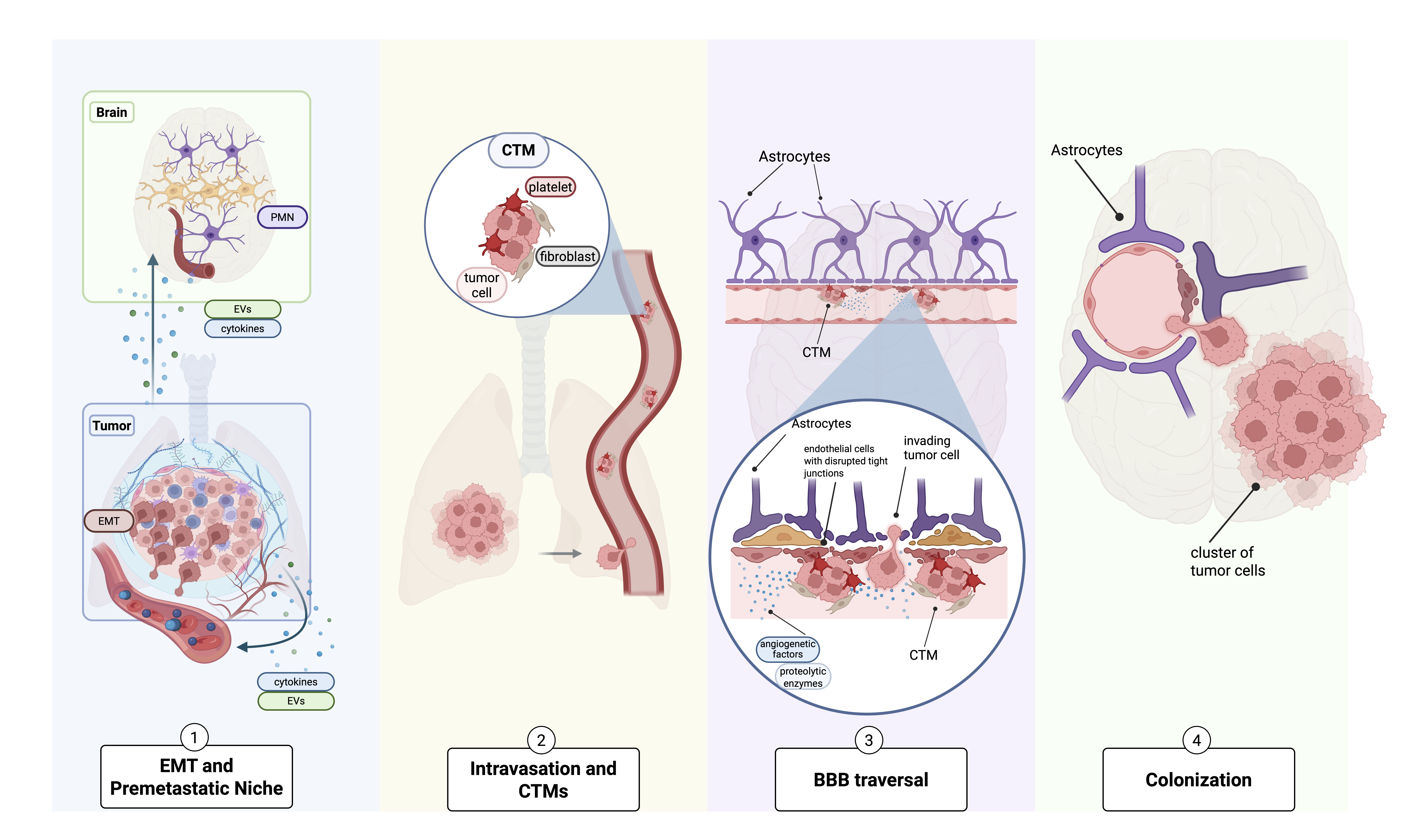
Brain metastases (BM) are a common and clinically significant complication of non-small cell lung cancer (NSCLC), representing a major contributor to its high mortality. Among all metastatic sites, involvement of the central nervous system (CNS) is associated with a particularly profound deterioration in patients' quality of life. The incidence of BM varies considerably across different histological subtypes and molecularly defined groups of NSCLC. The development of BM is a multistep process involving primary tumor invasion, hematogenous dissemination, blood-brain barrier (BBB) transmigration, and successful colonization of the brain. This process is strongly shaped by reciprocal interactions between the tumor cells and the unique brain tumor microenvironment (TME). Brain endothelial cells, pericytes, astrocytes, microglia, neurons, and recruited peripheral immune and stromal cells collectively regulate BBB permeability, immune evasion, extracellular matrix remodeling, and metastatic outgrowth. Compared with primary lung tumors, BM displays a distinct immune landscape characterized by reduced lymphocyte infiltration, enrichment of immunosuppressive myeloid populations, impaired antigen presentation, and extensive crosstalk with CNS-resident cells. These features contribute to therapeutic resistance and help explain the heterogeneous intracranial efficacy of systemic treatments. While immune checkpoint inhibitors and chemotherapy combinations provide benefit in selected patients, the most pronounced intracranial responses are observed with CNS-penetrant targeted therapies in molecularly defined subsets. Emerging strategies aim to directly target the metastatic niche, including myeloid cells, tumor vasculature, immune checkpoints, and cellular immunotherapies. A deeper understanding of the brain metastatic ecosystem may enable the development of more effective, biology-driven therapeutic approaches for NSCLC BM.
References
1. Bray F, Laversanne M, Sung H, Ferlay J, Siegel RL, Soerjomataram I, et al. Global cancer statistics 2022: GLOBOCAN estimates of incidence and mortality worldwide for 36 cancers in 185 countries. CA Cancer J Clin. 2024;74(3):229-263. doi:10.3322/caac.21834
2. Ganti AK, Klein AB, Cotarla I, Seal B, Chou E. Update of incidence, prevalence, survival, and initial treatment in patients with non-small cell lung cancer in the US. JAMA Oncol. 2021;7(12):1824-1832. doi:10.1001/jamaoncol.2021.4932
3. Berghoff AS, Schur S, Füreder LM, Gatterbauer B, Dieckmann K, Widhalm G, et al. Descriptive statistical analysis of a real life cohort of 2419 patients with brain metastases of solid cancers. ESMO Open. 2016;1(2):e000024. doi:10.1136/esmoopen-2015-000024
4. Zhang C, Zhang H, Jia W. Trends of incidence and survival of brain metastases from lung cancer. World Neurosurg. 2026;205:124636. doi:10.1016/j.wneu.2025.124636
5. Miccio JA, Tian Z, Mahase SS, Lin C, Choi S, Zacharia BE, et al. Estimating the risk of brain metastasis for patients newly diagnosed with cancer. Commun Med (Lond). 2024;4(1):27. doi:10.1038/s43856-024-00445-7
6. Gillespie CS, Mustafa MA, Richardson GE, Alam AM, Lee KS, Hughes DM, et al. Genomic alterations and the incidence of brain metastases in advanced and metastatic NSCLC: a systematic review and meta-analysis. J Thorac Oncol. 2023;18(12):1703-1713. doi:10.1016/j.jtho.2023.06.017
7. Cho BC, Lu S, Felip E, Spira AI, Girard N, Lee JS, et al. Amivantamab plus lazertinib in previously untreated EGFR-mutated advanced NSCLC. N Engl J Med. 2024;391(16):1486-1498. doi:10.1056/NEJMoa2403614
8. Planchard D, Jänne PA, Cheng Y, Yang JC-H, Yanagitani N, Kim SW, et al. Osimertinib with or without chemotherapy in EGFR-mutated advanced NSCLC. N Engl J Med. 2023;389(21):1935-1948. doi:10.1056/NEJMoa2306434
9. Achrol AS, Rennert RC, Anders C, Soffietti R, Ahluwalia MS, Nayak L, et al. Brain metastases. Nat Rev Dis Primers. 2019;5(1):5. doi:10.1038/s41572-018-0055-y
10. Chafe SC, Mobilio D, Zhai K, Kieliszek AM, Venugopal C, Singh SK. Emerging paradigms in the study of brain metastases. Sci Signal. 2026;19(932):eadj9726. doi:10.1126/scisignal.adj9726
11. Placone AL, Quiñones-Hinojosa A, Searson PC. The role of astrocytes in the progression of brain cancer: complicating the picture of the tumor microenvironment. Tumour Biol. 2016;37(1):61-69. doi:10.1007/s13277-015-4242-0
12. Kim SW, Choi HJ, Lee H-J, He J, Wu Q, Langley RR, et al. Role of the endothelin axis in astrocyte- and endothelial cell-mediated chemoprotection of cancer cells. Neuro Oncol. 2014;16(12):1585-1598. doi:10.1093/neuonc/nou128
13. Jin Y, Kang Y, Wang M, Wu B, Su B, Yin H, et al. Targeting polarized phenotype of microglia via IL6/JAK2/STAT3 signaling to reduce NSCLC brain metastasis. Signal Transduct Target Ther. 2022;7(1):52. doi:10.1038/s41392-022-00872-9
14. Xia Z, Liu W, Guo D, Chen L, Zhao M, Zhao Y, et al. circADAMTS12 inhibits the antitumor activity of microglia to enable metastatic colonization in the brain. Cancer Res. 2025;85(24):4977-4994. doi:10.1158/0008-5472.CAN-25-0738
15. Xu W, Patel N, Deng Y, Ding S, Wang T, Zhang H. Extracellular vesicle-derived LINC00482 induces microglial M2 polarization to facilitate brain metastasis of NSCLC. Cancer Lett. 2023;561:216146. doi:10.1016/j.canlet.2023.216146
16. Paget S. The distribution of secondary growths in cancer of the breast. Lancet. 1889;133(3421):571-573. doi:10.1016/S0140-6736(00)49915-0
17. Kim MS, Lee J, Lee JE, An JH, Heo JY, Yeo MK. Brain metastasis from non-small cell lung cancer: crosstalk between cancer cells and tumor microenvironment components. Exp Mol Med. 2025;57(12):2749-2762. doi:10.1038/s12276-025-01604-z
18. Gavert N, Ben-Ze’ev A. Epithelial-mesenchymal transition and the invasive potential of tumors. Trends Mol Med. 2008;14(5):199-209. doi:10.1016/j.molmed.2008.03.004
19. Peinado H, Zhang H, Matei IR, Costa-Silva B, Hoshino A, Rodrigues G, et al. Pre-metastatic niches: organ-specific homes for metastases. Nat Rev Cancer. 2017;17(5):302-317. doi:10.1038/nrc.2017.6
20. Hao Y, Baker D, Ten Dijke P. TGF-β-mediated epithelial-mesenchymal transition and cancer metastasis. Int J Mol Sci. 2019;20(11):2767. doi:10.3390/ijms20112767
21. Thuya WL, Cao Y, Ho PC-L, Wong AL-A, Wang L, Zhou J, et al. Insights into IL-6/JAK/STAT3 signaling in the tumor microenvironment: implications for cancer therapy. Cytokine Growth Factor Rev. 2025;85:26-42. doi:10.1016/j.cytogfr.2025.01.003
22. Zhao L, Ma X, Yu J. Exosomes and organ-specific metastasis. Mol Ther Methods Clin Dev. 2021;22:133-147. doi:10.1016/j.omtm.2021.05.016
23. Hoshino A, Costa-Silva B, Shen T-L, Rodrigues G, Hashimoto A, Tesic Mark M, et al. Tumour exosome integrins determine organotropic metastasis. Nature. 2015;527(7578):329-335. doi:10.1038/nature15756
24. Cheytan T, Schneider M, Würth R, Schwerd-Kleine P, Gutjahr E, Thewes V, et al. Small extracellular vesicles and particles (sEVPs) derived from tumor-free pre-metastatic organs promote breast cancer metastasis and support organotropism. Mol Cancer. 2025;24(1):72. doi:10.1186/s12943-025-02235-8
25. Donato C, Kunz L, Castro-Giner F, Paasinen-Sohns A, Strittmatter K, Szczerba BM, et al. Hypoxia triggers the intravasation of clustered circulating tumor cells. Cell Rep. 2020;32(10):108105. doi:10.1016/j.celrep.2020.108105
26. Lambert AW, Pattabiraman DR, Weinberg RA. Emerging biological principles of metastasis. Cell. 2017;168(4):670-691. doi:10.1016/j.cell.2016.11.037
27. Newcomer K, Bifolco A, Reeves S, Pontecorvi G, Asawa S, Sznurkowska MK, et al. Macrovascular tumor infiltration and circulating tumor cell cluster dynamics in patients with cancer approaching the end of life. Nat Med. 2025;31(12):4140-4149. doi:10.1038/s41591-025-03966-3
28. Frezzetti D, Gallo M, Roma C, D'Alessio A, Maiello MR, Bevilacqua S, et al. Vascular endothelial growth factor A regulates the secretion of different angiogenic factors in lung cancer cells. J Cell Physiol. 2016;231(7):1514-1521. doi:10.1002/jcp.25243
29. Jakab M, Lee KH, Uvarovskii A, Ovchinnikova S, Kulkarni SR, Jakab S, et al. Lung endothelium exploits susceptible tumor cell states to instruct metastatic latency. Nat Cancer. 2024;5(5):716-730. doi:10.1038/s43018-023-00716-7
30. Zhang Q, Abdo R, Iosef C, Kaneko T, Cecchini M, Han VK, et al. The spatial transcriptomic landscape of non-small cell lung cancer brain metastasis. Nat Commun. 2022;13(1):5983. doi:10.1038/s41467-022-33365-y
31. Münsterberg J, Loreth D, Brylka L, Werner S, Karbanova J, Gandrass M, et al. ALCAM contributes to brain metastasis formation in non-small-cell lung cancer through interaction with the vascular endothelium. Neuro Oncol. 2020;22(7):955-966. doi:10.1093/neuonc/noaa028
32. Rai S, Nejadhamzeeigilani Z, Gutowski NJ, Whatmore JL. Loss of the endothelial glycocalyx is associated with increased E-selectin mediated adhesion of lung tumour cells to the brain microvascular endothelium. J Exp Clin Cancer Res. 2015;34:105. doi:10.1186/s13046-015-0223-9
33. Jassam SA, Maherally Z, Smith JR, Ashkan K, Roncaroli F, Fillmore HL, et al. TNF-α enhancement of CD62E mediates adhesion of non-small cell lung cancer cells to brain endothelium via CD15 in lung-brain metastasis. Neuro Oncol. 2016;18(5):679-690. doi:10.1093/neuonc/nov248
34. Jassam SA, Maherally Z, Smith JR, Ashkan K, Roncaroli F, Fillmore HL, et al. CD15s/CD62E interaction mediates the adhesion of non-small cell lung cancer cells on brain endothelial cells: implications for cerebral metastasis. Int J Mol Sci. 2017;18(7):1474. doi:10.3390/ijms18071474
35. Jassam SA, Maherally Z, Ashkan K, Pilkington GJ, Fillmore HL. Fucosyltransferase 4 and 7 mediates adhesion of non-small cell lung cancer cells to brain-derived endothelial cells and results in modification of the blood-brain-barrier: in vitro investigation of CD15 and CD15s in lung-to-brain metastasis. J Neurooncol. 2019;143(3):405-415. doi:10.1007/s11060-019-03188-x
36. Yoshimatsu Y, Wakabayashi I, Kimuro S, Takahashi N, Takahashi K, Kobayashi M, et al. TNF-α enhances TGF-β-induced endothelial-to-mesenchymal transition via TGF-β signal augmentation. Cancer Sci. 2020;111(7):2385-2399. doi:10.1111/cas.14455
37. Ciccone V, Filippelli A, Bacchella C, Monzani E, Morbidelli L. The nitric oxide donor (Zn(PipNONO)Cl) exhibits antitumor activity through inhibition of epithelial and endothelial mesenchymal transitions. Cancers (Basel). 2022;14(17):4240. doi:10.3390/cancers14174240
38. Wu D, Deng S, Li L, Liu T, Zhang T, Li J, et al. TGF-β1-mediated exosomal lnc-MMP2-2 increases blood-brain barrier permeability via the miRNA-1207-5p/EPB41L5 axis to promote non-small cell lung cancer brain metastasis. Cell Death Dis. 2021;12(8):721. doi:10.1038/s41419-021-04004-z
39. Liu W, Song J, Du X, Zhou Y, Li Y, Li R, et al. AKR1B10 (Aldo-keto reductase family 1 B10) promotes brain metastasis of lung cancer cells in a multi-organ microfluidic chip model. Acta Biomater. 2019;91:195-208. doi:10.1016/j.actbio.2019.04.053
40. Lin CY, Cho CF, Bai ST, Liu JP, Kuo TT, Wang LJ, et al. ADAM9 promotes lung cancer progression through vascular remodeling by VEGFA, ANGPT2, and PLAT. Sci Rep. 2017;7(1):15108. doi:10.1038/s41598-017-15159-1
41. Amersfoort J, Eelen G, Carmeliet P. Immunomodulation by endothelial cells — partnering up with the immune system? Nat Rev Immunol. 2022;22(9):576-588. doi:10.1038/s41577-022-00694-4
42. Wang Y, Zhong A, Wang B, Zhai X, Lei C, Liang Z, et al. A blood-brain barrier-like vascular gate limits immunotherapy efficacy in neuroendocrine cancers. Cell. 2026;189(13):3922-3939.e20. doi:10.1016/j.cell.2026.04.017
43. Fujimoto T, Nakagawa S, Morofuji Y, Watanabe D, Ujifuku K, Horie N, et al. Pericytes suppress brain metastasis from lung cancer in vitro. Cell Mol Neurobiol. 2020;40(1):113-121. doi:10.1007/s10571-019-00725-0
44. Armulik A, Genové G, Mäe M, Nisancioglu MH, Wallgard E, Niaudet C, et al. Pericytes regulate the blood-brain barrier. Nature. 2010;468(7323):557-561. doi:10.1038/nature09522
45. Hellström M, Gerhardt H, Kalén M, Li X, Eriksson U, Wolburg H, et al. Lack of pericytes leads to endothelial hyperplasia and abnormal vascular morphogenesis. J Cell Biol. 2001;153(3):543-553. doi:10.1083/jcb.153.3.543
46. Zhao Z, Zhang Y, Zhang C, Zhang J, Luo X, Qiu Q, et al. TGF-β promotes pericyte-myofibroblast transition in subretinal fibrosis through the Smad2/3 and Akt/mTOR pathways. Exp Mol Med. 2022;54(5):673-684. doi:10.1038/s12276-022-00778-0
47. Lyle LT, Lockman PR, Adkins CE, Mohammad AS, Sechrest E, Hua E, et al. Alterations in pericyte subpopulations are associated with elevated blood-tumor barrier permeability in experimental brain metastasis of breast cancer. Clin Cancer Res. 2016;22(21):5287-5299. doi:10.1158/1078-0432.CCR-15-1836
48. Morikawa S, Baluk P, Kaidoh T, Haskell A, Jain RK, McDonald DM. Abnormalities in pericytes on blood vessels and endothelial sprouts in tumors. Am J Pathol. 2002;160(3):985-1000. doi:10.1016/S0002-9440(10)64920-6
49. Perrot CY, Herrera JL, Fournier-Goss AE, Komatsu M. Prostaglandin E2 breaks down pericyte-endothelial cell interaction via EP1 and EP4-dependent downregulation of pericyte N-cadherin, connexin-43, and R-Ras. Sci Rep. 2020;10(1):11186. doi:10.1038/s41598-020-68019-w
50. Xu S, Zhang H, Tian Y. Pericytes in hematogenous metastasis: mechanistic insights and therapeutic approaches. Cell Oncol. 2025;48(4):921-941. doi:10.1007/s13402-025-01073-6
51. Bejarano L, Kauzlaric A, Lamprou E, Lourenco J, Fournier N, Ballabio M, et al. Interrogation of endothelial and mural cells in brain metastasis reveals key immune-regulatory mechanisms. Cancer Cell. 2024;42(3):378-395.e10. doi:10.1016/j.ccell.2023.12.018
52. Linnerbauer M, Wheeler MA, Quintana FJ. Astrocyte crosstalk in CNS inflammation. Neuron. 2020;108(4):608-622. doi:10.1016/j.neuron.2020.08.012
53. Valiente M, Obenauf AC, Jin X, Chen Q, Zhang XH, Lee DJ, et al. Serpins promote cancer cell survival and vascular co-option in brain metastasis. Cell. 2014;156(5):1002-1016. doi:10.1016/j.cell.2014.01.040
54. Tominaga N, Kosaka N, Ono M, Katsuda T, Yoshioka Y, Tamura K, et al. Brain metastatic cancer cells release microRNA-181c-containing extracellular vesicles capable of destructing blood-brain barrier. Nat Commun. 2015;6:6716. doi:10.1038/ncomms7716
55. Ye L, Wu Y, Zhou J, Xie M, Zhang Z, Su C. Influence of exosomes on astrocytes in the pre-metastatic niche of lung cancer brain metastases. Biol Proced Online. 2023;25(1):5. doi:10.1186/s12575-023-00192-4
56. Manu DR, Slevin M, Barcutean L, Forro T, Boghitoiu T, Balasa R. Astrocyte involvement in blood-brain barrier function: a critical update highlighting novel, complex, neurovascular interactions. Int J Mol Sci. 2023;24(24):17146. doi:10.3390/ijms242417146
57. Sun S, Ke Z, Wang F, Li S, Chen W, Han A, et al. Overexpression of astrocyte-elevated gene-1 is closely correlated with poor prognosis in human non-small cell lung cancer and mediates its metastasis through up-regulation of matrix metalloproteinase-9 expression. Hum Pathol. 2012;43(7):1051-1060. doi:10.1016/j.humpath.2011.08.017
58. Zhou T, Yan Y, Lin M, Zeng C, Mao X, Zhu Y, et al. Astrocyte involvement in brain metastasis: from biological mechanisms to therapeutic strategies. Cancer Metastasis Rev. 2025;44(3):60. doi:10.1007/s10555-025-10276-0
59. Gril B, Paranjape AN, Woditschka S, Hua E, Dolan EL, Hanson J, et al. Reactive astrocytic S1P3 signaling modulates the blood-tumor barrier in brain metastases. Nat Commun. 2018;9(1):2705. doi:10.1038/s41467-018-05030-w
60. Wasilewski D, Priego N, Fustero-Torre C, Valiente M. Reactive astrocytes in brain metastasis. Front Oncol. 2017;7:298. doi:10.3389/fonc.2017.00298
61. Berrout J, Kyriakopoulou E, Moparthi L, Hogea AS, Berrout L, Ivan C, et al. TRPA1-FGFR2 binding event is a regulatory oncogenic driver modulated by miRNA-142-3p. Nat Commun. 2017;8(1):947. doi:10.1038/s41467-017-00983-w
62. Priego N, Zhu L, Monteiro C, Mulders M, Wasilewski D, Bindeman W, et al. STAT3 labels a subpopulation of reactive astrocytes required for brain metastasis. Nat Med. 2018;24(7):1024-1035. doi:10.1038/s41591-018-0044-4
63. Seike T, Fujita K, Yamakawa Y, Kido MA, Takiguchi S, Teramoto N, et al. Interaction between lung cancer cells and astrocytes via specific inflammatory cytokines in the microenvironment of brain metastasis. Clin Exp Metastasis. 2011;28(1):13-25. doi:10.1007/s10585-010-9354-8
64. Chen Q, Boire A, Jin X, Valiente M, Er EE, Lopez-Soto A, et al. Carcinoma-astrocyte gap junctions promote brain metastasis by cGAMP transfer. Nature. 2016;533(7604):493-498. doi:10.1038/nature18268
65. Tagore S, Caprio L, Amin AD, Bestak K, Luthria K, D'Souza E, et al. Single-cell and spatial genomic landscape of non-small cell lung cancer brain metastases. Nat Med. 2025;31(4):1351-1363. doi:10.1038/s41591-025-03530-z
66. Zhang L, Zhang S, Yao J, Lowery FJ, Zhang Q, Huang WC, et al. Microenvironment-induced PTEN loss by exosomal microRNA primes brain metastasis outgrowth. Nature. 2015;527(7576):100-104. doi:10.1038/nature15376
67. Lin Q, Balasubramanian K, Fan D, Kim SJ, Guo L, Wang H, et al. Reactive astrocytes protect melanoma cells from chemotherapy by sequestering intracellular calcium through gap junction communication channels. Neoplasia. 2010;12(9):748-754. doi:10.1593/neo.10602
68. Ghoochani A, Schwarz MA, Yakubov E, Engelhorn T, Doerfler A, Buchfelder M, et al. MIF-CD74 signaling impedes microglial M1 polarization and facilitates brain tumorigenesis. Oncogene. 2016;35(48):6246-6261. doi:10.1038/onc.2016.160
69. Tang M, Xu M, Wang J, Liu Y, Liang K, Jin Y, et al. Brain metastasis from EGFR-mutated non-small cell lung cancer: secretion of IL11 from astrocytes up-regulates PDL1 and promotes immune escape. Adv Sci (Weinh). 2024;11(26):e2306348. doi:10.1002/advs.202306348
70. Faust Akl C, Quintana FJ. Astrocyte-driven immunosuppression in the brain tumor microenvironment. Nat Immunol. 2026;27(5):912-922. doi:10.1038/s41590-026-02488-5
71. Dai W, Zhu H, Chen G, Gu H, Gu Y, Sun X, et al. Orchestration of the crosstalk between astrocytes and cancer cells affects the treatment and prognosis of lung cancer sufferers with brain metastasis. J Thorac Dis. 2016;8(11):E1450-E1454. doi:10.21037/jtd.2016.11.11
72. Nimmerjahn A, Kirchhoff F, Helmchen F. Resting microglial cells are highly dynamic surveillants of brain parenchyma in vivo. Science. 2005;308(5726):1314-1318. doi:10.1126/science.1110647
73. Davalos D, Grutzendler J, Yang G, Kim JV, Zuo Y, Jung S, et al. ATP mediates rapid microglial response to local brain injury in vivo. Nat Neurosci. 2005;8(6):752-758. doi:10.1038/nn1472
74. Mayer MG, Fischer T. Microglia at the blood brain barrier in health and disease. Front Cell Neurosci. 2024;18:1360195. doi:10.3389/fncel.2024.1360195
75. Cole AP, Hoffmeyer E, Lakshmana Chetty S, Cruz-Cruz J, Hamrick F, Youssef O, et al. Microglia in the brain tumor microenvironment. Adv Exp Med Biol. 2020;1273:197-208. doi:10.1007/978-3-030-49270-0_11
76. Haage V, Semtner M, Oliveira Vidal R, Perez Hernandez D, Pong WW, Chen Z, et al. Comprehensive gene expression meta-analysis identifies signature genes that distinguish microglia from peripheral monocytes/macrophages in health and glioma. Acta Neuropathol Commun. 2019;7(1):20. doi:10.1186/s40478-019-0665-y
77. Wes PD, Holtman IR, Boddeke EWGM, Möller T, Eggen BJL. Next generation transcriptomics and genomics elucidate biological complexity of microglia in health and disease. Glia. 2016;64(2):197-213. doi:10.1002/glia.22866
78. Ransohoff RM. A polarizing question: do M1 and M2 microglia exist? Nat Neurosci. 2016;19(8):987-991. doi:10.1038/nn.4338
79. Yuan A, Hsiao YJ, Chen HY, Chen HW, Ho CC, Chen YY, et al. Opposite effects of M1 and M2 macrophage subtypes on lung cancer progression. Sci Rep. 2015;5:14273. doi:10.1038/srep14273
80. He BP, Wang JJ, Zhang X, Wu Y, Wang M, Bay BH, Chang AYC. Differential reactions of microglia to brain metastasis of lung cancer. Mol Med. 2006;12(7-8):161-170. doi:10.2119/2006-00033.He
81. Darmanis S, Sloan SA, Croote D, Mignardi M, Chernikova S, Samghababi P, et al. Single-cell RNA-seq analysis of infiltrating neoplastic cells at the migrating front of human glioblastoma. Cell Rep. 2017;21(5):1399-1410. doi:10.1016/j.celrep.2017.10.030
82. Nakano Y, Kuroda E, Kito T, Uematsu S, Akira S, Yokota A, et al. Induction of prostaglandin E2 synthesis and microsomal prostaglandin E synthase-1 expression in murine microglia by glioma-derived soluble factors. J Neurosurg. 2008;108(2):311-319. doi:10.3171/JNS/2008/108/2/0311
83. Hao C, Beguinot F, Condorelli G, Trencia A, Van Meir EG, Yong VW, et al. Induction and intracellular regulation of tumor necrosis factor-related apoptosis-inducing ligand (TRAIL) mediated apoptosis in human malignant glioma cells. Cancer Res. 2001;61(3):1162-1170. PMID: 11221847
84. Badie B, Schartner J, Prabakaran S, Paul J, Vorpahl J. Expression of Fas ligand by microglia: possible role in glioma immune evasion. J Neuroimmunol. 2001;120(1-2):19-24. doi:10.1016/S0165-5728(01)00361-7
85. Klemm F, Maas RR, Bowman RL, Kornete M, Soukup K, Nassiri S, et al. Interrogation of the microenvironmental landscape in brain tumors reveals disease-specific alterations of immune cells. Cell. 2020;181(7):1643-1660.e17. doi:10.1016/j.cell.2020.05.007
86. Ye XZ, Xu SL, Xin YH, Yu SC, Ping YF, Chen L, et al. Tumor-associated microglia/macrophages enhance the invasion of glioma stem-like cells via TGF-β1 signaling pathway. J Immunol. 2012;189(1):444-453. doi:10.4049/jimmunol.1103248
87. Zhang J, Sarkar S, Cua R, Zhou Y, Hader W, Yong VW. A dialog between glioma and microglia that promotes tumor invasiveness through the CCL2/CCR2/interleukin-6 axis. Carcinogenesis. 2012;33(2):312-319. doi:10.1093/carcin/bgr289
88. Matsumoto J, Takata F, Machida T, Takahashi H, Soejima Y, Funakoshi M, et al. Tumor necrosis factor-α-stimulated brain pericytes possess a unique cytokine and chemokine release profile and enhance microglial activation. Neurosci Lett. 2014;578:133-138. doi:10.1016/j.neulet.2014.06.052
89. Wallmann T, Zhang XM, Wallerius M, Bolin S, Joly AL, Sobocki C, et al. Microglia induce PDGFRB expression in glioma cells to enhance their migratory capacity. iScience. 2018;9:71-83. doi:10.1016/j.isci.2018.10.011
90. Matias D, Dubois LG, Pontes B, Rosário L, Ferrer VP, Balça-Silva J, et al. GBM-derived Wnt3a induces M2-like phenotype in microglial cells through Wnt/β-catenin signaling. Mol Neurobiol. 2019;56(2):1517-1530. doi:10.1007/s12035-018-1150-5
91. Lepore F, D'Alessandro G, Antonangeli F, Santoro A, Esposito V, Limatola C, et al. CXCL16/CXCR6 axis drives microglia/macrophages phenotype in physiological conditions and plays a crucial role in glioma. Front Immunol. 2018;9:2750. doi:10.3389/fimmu.2018.02750
92. Abels ER, Maas SLN, Nieland L, Wei Z, Cheah PS, Tai E, et al. Glioblastoma-associated microglia reprogramming is mediated by functional transfer of extracellular miR-21. Cell Rep. 2019;28(12):3105-3119.e7. doi:10.1016/j.celrep.2019.08.036
93. Doron H, Pukrop T, Erez N. A blazing landscape: neuroinflammation shapes brain metastasis. Cancer Res. 2019;79(3):423-436. doi:10.1158/0008-5472.CAN-18-1805
94. Saponaro C, Cianciulli A, Calvello R, Dragone T, Iacobazzi F, Panaro MA. The PI3K/Akt pathway is required for LPS activation of microglial cells. Immunopharmacol Immunotoxicol. 2012;34(5):858-865. doi:10.3109/08923973.2012.665461
95. Cianciulli A, Porro C, Calvello R, Trotta T, Lofrumento DD, Panaro MA. Microglia mediated neuroinflammation: focus on PI3K modulation. Biomolecules. 2020;10(1):137. doi:10.3390/biom10010137
96. Vinnakota JM, Adams RC, Athanassopoulos D, Schmidt D, Biavasco F, Zähringer A, et al. Anti-PD-1 cancer immunotherapy induces central nervous system immune-related adverse events by microglia activation. Sci Transl Med. 2024;16(751):eadj9672. doi:10.1126/scitranslmed.adj9672
97. Liddelow SA, Guttenplan KA, Clarke LE, Bennett FC, Bohlen CJ, Schirmer L, et al. Neurotoxic reactive astrocytes are induced by activated microglia. Nature. 2017;541(7638):481-487. doi:10.1038/nature21029
98. Gillespie S, Monje M. An active role for neurons in glioma progression: making sense of Scherer’s structures. Neuro Oncol. 2018;20(10):1292-1299. doi:10.1093/neuonc/noy083
99. Venkatesh HS, Johung TB, Caretti V, Noll A, Tang Y, Nagaraja S, et al. Neuronal activity promotes glioma growth through neuroligin-3 secretion. Cell. 2015;161(4):803-816. doi:10.1016/j.cell.2015.04.012
100. Venkatesh H, Monje M. Neuronal activity in ontogeny and oncology. Trends Cancer. 2017;3(2):89-112. doi:10.1016/j.trecan.2016.12.008
101. Neman J, Termini J, Wilczynski S, Vaidehi N, Choy C, Kowolik CM, et al. Human breast cancer metastases to the brain display GABAergic properties in the neural niche. Proc Natl Acad Sci U S A. 2014;111(3):984-989. doi:10.1073/pnas.1322098111
102. Deshpande K, Martirosian V, Nakamura BN, Iyer M, Julian A, Eisenbarth R, et al. Neuronal exposure induces neurotransmitter signaling and synaptic mediators in tumors early in brain metastasis. Neuro Oncol. 2022;24(6):914-924. doi:10.1093/neuonc/noab290
103. Sakthivelu V, Schmitt A, Odenthal F, Ndoci K, Touet M, Shaib AH, et al. Functional synapses between neurons and small cell lung cancer. Nature. 2025;646(8087):1243-1253. doi:10.1038/s41586-025-09434-9
104. Caino MC, Seo JH, Aguinaldo A, Wait E, Bryant KG, Kossenkov AV, et al. A neuronal network of mitochondrial dynamics regulates metastasis. Nat Commun. 2016;7:13730. doi:10.1038/ncomms13730
105. Pu T, Sun J, Ren G, Li H. Neuro-immune crosstalk in cancer: mechanisms and therapeutic implications. Signal Transduct Target Ther. 2025;10(1):176. doi:10.1038/s41392-025-02241-8
106. Baruch EN, Gleber-Netto FO, Nagarajan P, Rao X, Akhter S, Eichwald T, et al. Cancer-induced nerve injury promotes resistance to anti-PD-1 therapy. Nature. 2025;646(8084):462-473. doi:10.1038/s41586-025-09370-8
107. Shapouri-Moghaddam A, Mohammadian S, Vazini H, Taghadosi M, Esmaeili SA, Mardani F, et al. Macrophage plasticity, polarization, and function in health and disease. J Cell Physiol. 2018;233(9):6425-6440. doi:10.1002/jcp.26429
108. Wang S, Wang J, Chen Z, Luo J, Guo W, Sun L. Targeting M2-like tumor-associated macrophages is a potential therapeutic approach to overcome antitumor drug resistance. NPJ Precis Oncol. 2024;8(1):31. doi:10.1038/s41698-024-00522-z
109. Jiang Y, Li Y, Zhu B. T-cell exhaustion in the tumor microenvironment. Cell Death Dis. 2015;6(6):e1792. doi:10.1038/cddis.2015.162
110. Yang L, Dong Y, Li Y, Wang D, Liu S, Wang D, et al. IL-10 derived from M2 macrophage promotes cancer stemness via JAK1/STAT1/NF-κB/Notch1 pathway in non-small cell lung cancer. Int J Cancer. 2019;145(4):1099-1110. doi:10.1002/ijc.32151
111. Liu L, Ge D, Ma L, Mei J, Liu S, Zhang Q, et al. Interleukin-17 and prostaglandin E2 are involved in formation of an M2 macrophage-dominant microenvironment in lung cancer. J Thorac Oncol. 2012;7(7):1091-1100. doi:10.1097/JTO.0b013e3182542752
112. Zhou D, Xia Z, Xie M, Gao Y, Yu Q, He B. Exosomal long non-coding RNA SOX2 overlapping transcript enhances the resistance to EGFR-TKIs in non-small cell lung cancer cell line H1975. Hum Cell. 2021;34(5):1478-1489. doi:10.1007/s13577-021-00572-6
113. Rath M, Müller I, Kropf P, Closs EI, Munder M. Metabolism via arginase or nitric oxide synthase: two competing arginine pathways in macrophages. Front Immunol. 2014;5:532. doi:10.3389/fimmu.2014.00532
114. Wang R, Zhang J, Chen S, Lu M, Luo X, Yao S, et al. Tumor-associated macrophages provide a suitable microenvironment for non-small lung cancer invasion and progression. Lung Cancer. 2011;74(2):188-196. doi:10.1016/j.lungcan.2011.04.009
115. Chuang HN, van Rossum D, Sieger D, Siam L, Klemm F, Bleckmann A, et al. Carcinoma cells misuse the host tissue damage response to invade the brain. Glia. 2013;61(8):1331-1346. doi:10.1002/glia.22518
116. Wang Y, Chang T, Wu T, Xu W, Dou G, Wang Y, et al. M2 macrophages promote vasculogenesis during retinal neovascularization by regulating bone marrow-derived cells via SDF-1/VEGF. Cell Tissue Res. 2020;380(3):469-486. doi:10.1007/s00441-019-03166-9
117. Bowman RL, Klemm F, Akkari L, Pyonteck SM, Sevenich L, Quail DF, et al. Macrophage ontogeny underlies differences in tumor-specific education in brain malignancies. Cell Rep. 2016;17(9):2445-2459. doi:10.1016/j.celrep.2016.10.052
118. Kim N, Kim HK, Lee K, Hong Y, Cho JH, Choi JW, et al. Single-cell RNA sequencing demonstrates the molecular and cellular reprogramming of metastatic lung adenocarcinoma. Nat Commun. 2020;11(1):2285. doi:10.1038/s41467-020-16164-1
119. Shin DH, Jo JY, Kim SH, Choi M, Han C, Choi BK, et al. Midkine is a potential therapeutic target of tumorigenesis, angiogenesis, and metastasis in non-small cell lung cancer. Cancers (Basel). 2020;12(9):2402. doi:10.3390/cancers12092402
120. Molgora M, Esaulova E, Vermi W, Hou J, Chen Y, Luo J, et al. TREM2 modulation remodels the tumor myeloid landscape enhancing anti-PD-1 immunotherapy. Cell. 2020;182(4):886-900.e17. doi:10.1016/j.cell.2020.07.013
121. Zhang H, Liu Z, Wen H, Guo Y, Xu F, Zhu Q, et al. Immunosuppressive TREM2(+) macrophages are associated with undesirable prognosis and responses to anti-PD-1 immunotherapy in non-small cell lung cancer. Cancer Immunol Immunother. 2022;71(10):2511-2522. doi:10.1007/s00262-022-03173-w
122. Yang F, Akhtar MN, Zhang D, El-Mayta R, Shin J, Dorsey JF, et al. An immunosuppressive vascular niche drives macrophage polarization and immunotherapy resistance in glioblastoma. Sci Adv. 2024;10(9):eadj4678. doi:10.1126/sciadv.adj4678
123. Szczerba BM, Castro-Giner F, Vetter M, Krol I, Gkountela S, Landin J, et al. Neutrophils escort circulating tumour cells to enable cell cycle progression. Nature. 2019;566(7745):553-557. doi:10.1038/s41586-019-0915-y
124. Hu C, Long L, Lou J, Leng M, Yang Q, Xu X, Zhou X. CTC-neutrophil interaction: a key driver and therapeutic target of cancer metastasis. Biomed Pharmacother. 2024;180:117474. doi:10.1016/j.biopha.2024.117474
125. Schreurs LD, Vom Stein AF, Jünger ST, Timmer M, Noh KW, Buettner R, et al. The immune landscape in brain metastasis. Neuro Oncol. 2025;27(1):50-62. doi:10.1093/neuonc/noae219
126. Maas RR, Soukup K, Fournier N, Massara M, Galland S, Kornete M, et al. The local microenvironment drives activation of neutrophils in human brain tumors. Cell. 2023;186(21):4546-4566.e27. doi:10.1016/j.cell.2023.08.043
127. Li M, Hou X, Sai K, Wu L, Chen J, Zhang B, et al. Immune suppressive microenvironment in brain metastatic non-small cell lung cancer: comprehensive immune microenvironment profiling of brain metastases versus paired primary lung tumors (GASTO 1060). Oncoimmunology. 2022;11(1):2059874. doi:10.1080/2162402X.2022.2059874
128. Stankovic B, Bjørhovde HAK, Skarshaug R, Aamodt H, Frafjord A, Müller E, et al. Immune cell composition in human non-small cell lung cancer. Front Immunol. 2019;9:3101. doi:10.3389/fimmu.2018.03101
129. Gonzalez H, Mei W, Robles I, Hagerling C, Allen BM, Okholm TLH, et al. Cellular architecture of human brain metastases. Cell. 2022;185(4):729-745.e20. doi:10.1016/j.cell.2021.12.043
130. Lin H, Liu C, Hu A, Zhang D, Yang H. Understanding the immunosuppressive microenvironment of glioma: mechanistic insights and clinical perspectives. J Hematol Oncol. 2024;17:31. doi:10.1186/s13045-024-01544-7
131. Tsai YM, Wu KL, Liu YW, Chang WA, Huang YC, Chang CY, et al. Cooperation between cancer and fibroblasts in vascular mimicry and N2-type neutrophil recruitment via Notch2-Jagged1 interaction in lung cancer. Front Oncol. 2021;11:696931. doi:10.3389/fonc.2021.696931
132. Fridlender ZG, Sun J, Kim S, Kapoor V, Cheng G, Ling L, et al. Polarization of tumor-associated neutrophil phenotype by TGF-beta: "N1" versus "N2" TAN. Cancer Cell. 2009;16(3):183-194. doi:10.1016/j.ccr.2009.06.017
133. Salcher S, Sturm G, Horvath L, Untergasser G, Kuempers C, Fotakis G, et al. High-resolution single-cell atlas reveals diversity and plasticity of tissue-resident neutrophils in non-small cell lung cancer. Cancer Cell. 2022;40(12):1503-1520.e8. doi:10.1016/j.ccell.2022.10.008
134. Horvath L, Puschmann C, Scheiber A, Martowicz A, Sturm G, Trajanoski Z, et al. Beyond binary: bridging neutrophil diversity to new therapeutic approaches in NSCLC. Trends Cancer. 2024;10(5):457-474. doi:10.1016/j.trecan.2024.01.010
135. Sun HF, Li LD, Lao IW, Li X, Xu BJ, Cao YQ, et al. Single-cell RNA sequencing reveals cellular and molecular reprograming landscape of gliomas and lung cancer brain metastases. Clin Transl Med. 2022;12(11):e1101. doi:10.1002/ctm2.1101
136. Adler O, Zait Y, Cohen N, Blazquez R, Doron H, Monteran L, et al. Reciprocal interactions between innate immune cells and astrocytes facilitate neuroinflammation and brain metastasis via lipocalin-2. Nat Cancer. 2023;4(3):401-418. doi:10.1038/s43018-023-00519-w
137. Cools-Lartigue J, Spicer J, McDonald B, Gowing S, Chow S, Giannias B, et al. Neutrophil extracellular traps sequester circulating tumor cells and promote metastasis. J Clin Invest. 2013;123(8):3446-3458. doi:10.1172/JCI67484
138. Liu Y, Kosaka A, Ikeura M, Kohanbash G, Fellows-Mayle W, Snyder LA, et al. Premetastatic soil and prevention of breast cancer brain metastasis. Neuro Oncol. 2013;15(7):891-903. doi:10.1093/neuonc/not031
139. Sprenkeler EGG, Zandstra J, van Kleef ND, Goetschalckx I, Verstegen B, Aarts CEMA, et al. S100A8/A9 is a marker for the release of neutrophil extracellular traps and induces neutrophil activation. Cells. 2022;11(2):236. doi:10.3390/cells11020236
140. Zhou H, Zhao C, Shao R, Xu Y, Zhao W. The functions and regulatory pathways of S100A8/A9 and its receptors in cancers. Front Pharmacol. 2023;14:1187741. doi:10.3389/fphar.2023.1187741
141. Cho A, Kranawetter B, Untersteiner H, Khalaveh F, Dorfer C, Rössler K, et al. Neutrophil-to-lymphocyte ratio is superior to other leukocyte-based ratios as a prognostic predictor in non-small cell lung cancer patients with radiosurgically treated brain metastases under immunotherapy or targeted therapy. World Neurosurg. 2021;151:e324-e331. doi:10.1016/j.wneu.2021.04.033
142. Mitsuya K, Nakasu Y, Kurakane T, Hayashi N, Harada H, Nozaki K. Elevated preoperative neutrophil-to-lymphocyte ratio as a predictor of worse survival after resection in patients with brain metastasis. J Neurosurg. 2017;127(2):433-437. doi:10.3171/2016.8.JNS16899
143. Mao X, Xu J, Wang W, Liang C, Hua J, Liu J, et al. Crosstalk between cancer-associated fibroblasts and immune cells in the tumor microenvironment: new findings and future perspectives. Mol Cancer. 2021;20(1):131. doi:10.1186/s12943-021-01428-1
144. Elyada E, Bolisetty M, Laise P, Flynn WF, Courtois ET, Burkhart RA, et al. Cross-species single-cell analysis of pancreatic ductal adenocarcinoma reveals antigen-presenting cancer-associated fibroblasts. Cancer Discov. 2019;9(8):1102-1123. doi:10.1158/2159-8290.CD-19-0094
145. Lambrechts D, Wauters E, Boeckx B, Aibar S, Nittner D, Burton O, et al. Phenotype molding of stromal cells in the lung tumor microenvironment. Nat Med. 2018;24(8):1277-1289. doi:10.1038/s41591-018-0096-5
146. Xu K, Wang H, Zou YX, Zhang HH, Wang YN, Ren XR, et al. Distinct fibroblast subpopulations associated with bone, brain or intrapulmonary metastasis in advanced non-small-cell lung cancer. Clin Transl Med. 2024;14(3):e1605. doi:10.1002/ctm2.1605
147. Salam SMA, Jahan E, Ahn EJ, Kim SS, Kim YJ, Park SJ, et al. Brain metastasis-associated cancer fibroblasts drive tumor progression and therapeutic resistance through IL26 and CX3CL1 signaling in non-small-cell lung cancer. Exp Hematol Oncol. 2025;14(1):120. doi:10.1186/s40164-025-00713-9
148. Yang F, Yan Y, Yang Y, Hong X, Wang M, Yang Z, et al. MiR-210 in exosomes derived from CAFs promotes non-small cell lung cancer migration and invasion through PTEN/PI3K/AKT pathway. Cell Signal. 2020;73:109675. doi:10.1016/j.cellsig.2020.109675
149. Abulaiti A, Shintani Y, Funaki S, Nakagiri T, Inoue M, Sawabata N, et al. Interaction between non-small-cell lung cancer cells and fibroblasts via enhancement of TGF-β signaling by IL-6. Lung Cancer. 2013;82(2):204-213. doi:10.1016/j.lungcan.2013.08.008
150. Merchant N, Nagaraju GP, Rajitha B, Lammata S, Jella KK, Buchwald ZS, et al. Matrix metalloproteinases: their functional role in lung cancer. Carcinogenesis. 2017;38(8):766-780. doi:10.1093/carcin/bgx063
151. Zarodniuk M, Steele A, Lu X, Li J, Datta M. CNS tumor stroma transcriptomics identify perivascular fibroblasts as predictors of immunotherapy resistance in glioblastoma patients. NPJ Genom Med. 2023;8(1):35. doi:10.1038/s41525-023-00381-w
152. Bremnes RM, Dønnem T, Al-Saad S, Al-Shibli K, Andersen S, Sirera R, et al. The role of tumor stroma in cancer progression and prognosis: emphasis on carcinoma-associated fibroblasts and non-small cell lung cancer. J Thorac Oncol. 2011;6(1):209-217. doi:10.1097/JTO.0b013e3181f8a1bd
153. Mathieson L, Koppensteiner L, Dorward DA, O’Connor RA, Akram AR. Cancer-associated fibroblasts expressing fibroblast activation protein and podoplanin in non-small cell lung cancer predict poor clinical outcome. Br J Cancer. 2024;130(11):1758-1769. doi:10.1038/s41416-024-02671-1
154. Schulze AB, Schmidt LH, Heitkötter B, Huss S, Mohr M, Marra A, et al. Prognostic impact of CD34 and SMA in cancer-associated fibroblasts in stage I-III NSCLC. Thorac Cancer. 2020;11(1):120-129. doi:10.1111/1759-7714.13248
155. Prakash J, Shaked Y. The interplay between extracellular matrix remodeling and cancer therapeutics. Cancer Discov. 2024;14(8):1375-1388. doi:10.1158/2159-8290.CD-24-0002
156. Yuan Z, Li Y, Zhang S, Wang X, Dou H, Yu X, et al. Extracellular matrix remodeling in tumor progression and immune escape: from mechanisms to treatments. Mol Cancer. 2023;22(1):48. doi:10.1186/s12943-023-01744-8
157. Friebel E, Kapolou K, Unger S, Gonzalo Núñez N, Utz S, Rushing EJ, et al. Single-cell mapping of human brain cancer reveals tumor-specific instruction of tissue-invading leukocytes. Cell. 2020;181(7):1626-1642.e20. doi:10.1016/j.cell.2020.04.055
158. Sudmeier LJ, Hoang KB, Nduom EK, Wieland A, Neill SG, Schniederjan MJ, et al. Distinct phenotypic states and spatial distribution of CD8+ T cell clonotypes in human brain metastases. Cell Rep Med. 2022;3(5):100620. doi:10.1016/j.xcrm.2022.100620
159. Lu BY, Gupta R, Aguirre-Ducler A, Gianino N, Wyatt H, Ribeiro M, et al. Spatially resolved analysis of the T cell immune contexture in lung cancer-associated brain metastases. J Immunother Cancer. 2021;9(10):e002684. doi:10.1136/jitc-2021-002684
160. Berghoff AS, Fuchs E, Ricken G, Mlecnik B, Bindea G, Spanberger T, et al. Density of tumor-infiltrating lymphocytes correlates with extent of brain edema and overall survival time in patients with brain metastases. Oncoimmunology. 2016;5(1):e1057388. doi:10.1080/2162402X.2015.1057388
161. Berghoff AS, Ricken G, Wilhelm D, Rajky O, Widhalm G, Dieckmann K, et al. Tumor infiltrating lymphocytes and PD-L1 expression in brain metastases of small cell lung cancer (SCLC). J Neurooncol. 2016;130(1):19-29. doi:10.1007/s11060-016-2216-8
162. Jacobs JFM, Idema AJ, Bol KF, Nierkens S, Grauer OM, Wesseling P, et al. Regulatory T cells and the PD-L1/PD-1 pathway mediate immune suppression in malignant human brain tumors. Neuro Oncol. 2009;11(4):394-402. doi:10.1215/15228517-2008-104
163. Tanaka A, Sakaguchi S. Regulatory T cells in cancer immunotherapy. Cell Res. 2017;27(1):109-118. doi:10.1038/cr.2016.151
164. Ooi YC, Tran P, Ung N, Thill K, Trang A, Fong BM, et al. The role of regulatory T-cells in glioma immunology. Clin Neurol Neurosurg. 2014;119:125-132. doi:10.1016/j.clineuro.2013.12.004
165. Ren F, Zhao Q, Huang L, Zheng Y, Li L, He Q, et al. The R132H mutation in IDH1 promotes the recruitment of NK cells through CX3CL1/CX3CR1 chemotaxis and is correlated with a better prognosis in gliomas. Immunol Cell Biol. 2019;97(5):457-469. doi:10.1111/imcb.12225
166. Balatsoukas A, Rossignoli F, Shah K. NK cells in the brain: implications for brain tumor development and therapy. Trends Mol Med. 2022;28(3):194-209. doi:10.1016/j.molmed.2021.12.008
167. Fang X, Guo L, Xing Z, Shi L, Liang H, Li A, et al. IDO1 can impair NK cells function against non-small cell lung cancer by downregulation of NKG2D ligand via ADAM10. Pharmacol Res. 2022;177:106132. doi:10.1016/j.phrs.2022.106132
168. Malladi S, Macalinao DG, Jin X, He L, Basnet H, Zou Y, et al. Metastatic latency and immune evasion through autocrine inhibition of WNT. Cell. 2016;165(1):45-60. doi:10.1016/j.cell.2016.02.025
169. Palano MT, Gallazzi M, Cucchiara M, De Lerma Barbaro A, Gallo D, Bassani B, et al. Neutrophil and natural killer cell interactions in cancers: dangerous liaisons instructing immunosuppression and angiogenesis. Vaccines (Basel). 2021;9(12):1488. doi:10.3390/vaccines9121488
170. McLaughlin Q, Sojka DK, Kennedy K, Piersma SJ, Sethakorn N. Unleashing NK cells for cancer immunotherapy in lung cancer: biologic challenges and clinical advances. J Exp Clin Cancer Res. 2025;44(1):251. doi:10.1186/s13046-025-03503-7
171. Meng X, Gao Y, Yang L, Jing H, Teng F, Huang Z, et al. Immune microenvironment differences between squamous and non-squamous non-small-cell lung cancer and their influence on the prognosis. Clin Lung Cancer. 2019;20(1):48-58. doi:10.1016/j.cllc.2018.09.012
172. Fang X, Li D, Wan S, Hu J, Zhang P, Jie D, et al. Insights into the heterogeneity of the tumor microenvironment in lung adenocarcinoma and squamous carcinoma through single-cell transcriptomic analysis: implications for distinct immunotherapy outcomes. J Gene Med. 2024;26(6):e3694. doi:10.1002/jgm.3694
173. Fu D, Zhang B, Zhang Y, Feng J, Jiang H. Immunogenomic classification of lung squamous cell carcinoma characterizes tumor immune microenvironment and predicts cancer therapy. Genes Dis. 2023;10(6):2274-2277. doi:10.1016/j.gendis.2023.01.022
174. Souza VGP, Telkar N, Lam WL, Reis PP. Comprehensive analysis of lung adenocarcinoma and brain metastasis through integrated single-cell transcriptomics. Int J Mol Sci. 2024;25(7):3779. doi:10.3390/ijms25073779
175. Kudo Y, Haymaker C, Zhang J, Reuben A, Duose DY, Fujimoto J, et al. Suppressed immune microenvironment and repertoire in brain metastases from patients with resected non-small-cell lung cancer. Ann Oncol. 2019;30(9):1521-1530. doi:10.1093/annonc/mdz207
176. Ikarashi D, Okimoto T, Shukuya T, Onagi H, Hayashi T, Sinicropi-Yao SL, et al. Comparison of tumor microenvironments between primary tumors and brain metastases in patients with NSCLC. JTO Clin Res Rep. 2021;2(10):100230. doi:10.1016/j.jtocrr.2021.100230
177. Nogales-Pons M, Munárriz-Paños M, Aceña-Gonzalo T, Casanova-Acebes M. Myeloid diversity in tumors: shaped by genes, location, and time. J Exp Med. 2026;223(4):e20252267. doi:10.1084/jem.20252267
178. Zhou J, Gong Z, Jia Q, Wu Y, Yang ZZ, Zhu B. Programmed death ligand 1 expression and CD8+ tumor-infiltrating lymphocyte density differences between paired primary and brain metastatic lesions in non-small cell lung cancer. Biochem Biophys Res Commun. 2018;498(4):751-757. doi:10.1016/j.bbrc.2018.03.053
179. Moutafi MK, Tao W, Huang R, Haberberger J, Alexander B, Ramkissoon S, et al. Comparison of programmed death-ligand 1 protein expression between primary and metastatic lesions in patients with lung cancer. J Immunother Cancer. 2021;9(4):e002230. doi:10.1136/jitc-2020-002230
180. Liu JS, Cai YX, He YZ, Xu J, Tian SF, Li ZQ. Spatial and temporal heterogeneity of tumor immune microenvironment between primary tumor and brain metastases in NSCLC. BMC Cancer. 2024;24(1):123. doi:10.1186/s12885-024-11875-w
181. Mansfield AS, Ren H, Sutor S, Sarangi V, Nair A, Davila J, et al. Contraction of T cell richness in lung cancer brain metastases. Sci Rep. 2018;8(1):2171. doi:10.1038/s41598-018-20622-8
182. Wischnewski V, Maas RR, Guerrero Aruffo P, Soukup K, Galletti G, Kornete M, et al. Phenotypic diversity of T cells in human primary and metastatic brain tumors revealed by multiomic interrogation. Nat Cancer. 2023;4(6):908-924. doi:10.1038/s43018-023-00566-3
183. Jiang T, Yan Y, Zhou K, Su C, Ren S, Li N, et al. Characterization of evolution trajectory and immune profiling of brain metastasis in lung adenocarcinoma. NPJ Precis Oncol. 2021;5(1):6. doi:10.1038/s41698-021-00151-w
184. Shih DJH, Nayyar N, Bihun I, Dagogo-Jack I, Gill CM, Aquilanti E, et al. Genomic characterization of human brain metastases identifies drivers of metastatic lung adenocarcinoma. Nat Genet. 2020;52(4):371-377. doi:10.1038/s41588-020-0592-7
185. Vassella E, Kashani E, Zens P, Kündig A, Fung C, Scherz A, et al. Mutational profiles of primary pulmonary adenocarcinoma and paired brain metastases disclose the importance of KRAS mutations. Eur J Cancer. 2021;159:227-236. doi:10.1016/j.ejca.2021.10.006
186. Lengel HB, Mastrogiacomo B, Connolly JG, Tan KS, Liu Y, Fick CN, et al. Genomic mapping of metastatic organotropism in lung adenocarcinoma. Cancer Cell. 2023;41(5):970-985.e3. doi:10.1016/j.ccell.2023.03.018
187. Li L, Liu Z, Han R, Li L, Wang M, Huang D, et al. Genetic heterogeneity between paired primary and brain metastases in lung adenocarcinoma. Clin Med Insights Oncol. 2020;14:1179554920947335. doi:10.1177/1179554920947335
188. Nicoś M, Harbers L, Patrucco E, Kramer-Drauberg M, Zhang X, Voena C, et al. Genomic profiling identifies putative pathogenic alterations in NSCLC brain metastases. JTO Clin Res Rep. 2022;3(12):100435. doi:10.1016/j.jtocrr.2022.100435
189. Mansfield AS, Herbst RS, de Castro G Jr, Hui R, Peled N, Kim DW, et al. Outcomes with pembrolizumab monotherapy in patients with programmed death-ligand 1-positive NSCLC with brain metastases: pooled analysis of KEYNOTE-001, 010, 024, and 042. JTO Clin Res Rep. 2021;2(8):100205. doi:10.1016/j.jtocrr.2021.100205
190. Gadgeel SM, Lukas RV, Goldschmidt J, Conkling P, Park K, Cortinovis D, et al. Atezolizumab in patients with advanced non-small cell lung cancer and history of asymptomatic, treated brain metastases: exploratory analyses of the phase III OAK study. Lung Cancer. 2019;128:105-112. doi:10.1016/j.lungcan.2018.12.017
191. Rittmeyer A, Barlesi F, Waterkamp D, Park K, Ciardiello F, von Pawel J, et al. Atezolizumab versus docetaxel in patients with previously treated non-small-cell lung cancer (OAK): a phase 3, open-label, multicentre randomised controlled trial. Lancet. 2017;389(10066):255-265. doi:10.1016/S0140-6736(16)32517-X
192. Debieuvre D, Juergens RA, Asselain B, Audigier-Valette C, Auliac JB, Barlesi F, et al. Two-year survival with nivolumab in previously treated advanced non-small-cell lung cancer: a real-world pooled analysis of patients from France, Germany, and Canada. Lung Cancer. 2021;157:40-47. doi:10.1016/j.lungcan.2021.04.022
193. Kilickap S, Özgüroğlu M, Sezer A, Gümüş M, Bondarenko I, Gogishvili M, et al. Cemiplimab monotherapy as first-line treatment of patients with brain metastases from advanced non-small cell lung cancer with programmed cell death-ligand 1 ≥50. Cancer. 2025;131(10):e35864. doi:10.1002/cncr.35864
194. Reck M, Ciuleanu TE, Lee JS, Schenker M, Zurawski B, Kim SW, et al. Systemic and intracranial outcomes with first-line nivolumab plus ipilimumab in patients with metastatic NSCLC and baseline brain metastases from CheckMate 227 Part 1. J Thorac Oncol. 2023;18(8):1055-1069. doi:10.1016/j.jtho.2023.04.021
195. Goldberg SB, Schalper KA, Gettinger SN, Mahajan A, Herbst RS, Chiang AC, et al. Pembrolizumab for management of patients with NSCLC and brain metastases: long-term results and biomarker analysis from a non-randomised, open-label, phase 2 trial. Lancet Oncol. 2020;21(5):655-663. doi:10.1016/S1470-2045(20)30111-X
196. Ready NE, Audigier-Valette C, Goldman JW, Felip E, Ciuleanu TE, García Campelo MR, et al. First-line nivolumab plus ipilimumab for metastatic non-small cell lung cancer, including patients with ECOG performance status 2 and other special populations: CheckMate 817. J Immunother Cancer. 2023;11(2):e006127. doi:10.1136/jitc-2022-006127
197. Goldberg SB, Gettinger SN, Mahajan A, Chiang AC, Herbst RS, Sznol M, et al. Pembrolizumab for patients with melanoma or non-small-cell lung cancer and untreated brain metastases: early analysis of a non-randomized, open-label, phase 2 trial. Lancet Oncol. 2016;17(7):976-983. doi:10.1016/S1470-2045(16)30053-5
198. Nadal E, Rodríguez-Abreu D, Simó M, Massutí B, Juan O, Huidobro G, et al. Phase II trial of atezolizumab combined with carboplatin and pemetrexed for patients with advanced nonsquamous non-small-cell lung cancer with untreated brain metastases (Atezo-Brain, GECP17/05). J Clin Oncol. 2023;41(28):4478-4485. doi:10.1200/JCO.22.02561
199. Hou X, Zhou C, Wu G, Lin W, Xie Z, Zhang H, et al. Efficacy, safety, and health-related quality of life with camrelizumab plus pemetrexed and carboplatin as first-line treatment for advanced nonsquamous NSCLC with brain metastases (CAP-BRAIN): a multicenter, open-label, single-arm, phase 2 study. J Thorac Oncol. 2023;18(6):769-779. doi:10.1016/j.jtho.2023.01.083
200. Nadal E, Cantero A, Paz-Ares L, Ortega AL, Barba A, Iranzo P, et al. NIVIPI-Brain: phase 2 study of nivolumab + ipilimumab combined with chemotherapy in NSCLC with synchronous brain metastases. J Thorac Oncol. 2025;20(10 Suppl 1):S19-S20. doi:10.1016/j.jtho.2025.09.044
201. Heudobler D, Schulz C, Griesinger F, Hoffmann J, Illerhaus G, Knott M, et al. Nivolumab, ipilimumab and bevacizumab together with 2 cycles of induction chemotherapy in patients with non-squamous NSCLC and untreated brain metastases (CA209-7WF/Break B5-BM-NSCLC/AIO-TRK-0220/ass). Ann Oncol. 2025;36(Suppl 2):S453-S454. doi:10.1016/j.annonc.2025.08.1233
202. Powell SF, Rodríguez-Abreu D, Langer CJ, Tafreshi A, Paz-Ares L, Kopp HG, et al. Outcomes with pembrolizumab plus platinum-based chemotherapy for patients with NSCLC and stable brain metastases: pooled analysis of KEYNOTE-021, -189, and -407. J Thorac Oncol. 2021;16(11):1883-1892. doi:10.1016/j.jtho.2021.06.020
203. Sezer A, Kilickap S, Gümüş M, Bondarenko I, Özgüroğlu M, Gogishvili M, et al. Cemiplimab monotherapy for first-line treatment of advanced non-small-cell lung cancer with PD-L1 of at least 50%: a multicentre, open-label, global, phase 3, randomized, controlled trial (EMPOWER-Lung 1). Lancet. 2021;397(10274):592-604. doi:10.1016/S0140-6736(21)00228-2
204. Reck M, Ciuleanu TE, Schenker M, Bordenave S, Cobo M, Juan-Vidal O, et al. Five-year outcomes with first-line nivolumab plus ipilimumab with 2 cycles of chemotherapy versus 4 cycles of chemotherapy alone in patients with metastatic non-small cell lung cancer in the randomized CheckMate 9LA trial. Eur J Cancer. 2024;211:114296. doi:10.1016/j.ejca.2024.114296
205. Paz-Ares LG, Ciuleanu TE, Cobo M, Bennouna J, Schenker M, Cheng Y, et al. First-line nivolumab plus ipilimumab with chemotherapy versus chemotherapy alone for metastatic NSCLC in CheckMate 9LA: 3-year clinical update and outcomes in patients with brain metastases or select somatic mutations. J Thorac Oncol. 2023;18(2):204-222. doi:10.1016/j.jtho.2022.10.014
206. Carbone D, Ciuleanu T, Cobo M, Schenker M, Zurawski B, Menezes J, et al. OA09.01 First-line nivolumab + ipilimumab + chemo in patients with advanced NSCLC and brain metastases: results from CheckMate 9LA. J Thorac Oncol. 2021;16(10):S862. doi:10.1016/j.jtho.2021.08.061
207. Nogami N, Barlesi F, Socinski MA, Reck M, Thomas CA, Cappuzzo F, et al. IMpower150 final exploratory analyses for atezolizumab plus bevacizumab and chemotherapy in key NSCLC patient subgroups with EGFR mutations or metastases in the liver or brain. J Thorac Oncol. 2022;17(2):309-323. doi:10.1016/j.jtho.2021.09.014
208. Kienast Y, von Baumgarten L, Fuhrmann M, Klinkert WEF, Goldbrunner R, Herms J, et al. Real-time imaging reveals the single steps of brain metastasis formation. Nat Med. 2010;16(1):116-122. doi:10.1038/nm.2072
209. Besse B, Le Moulec S, Mazières J, Senellart H, Barlesi F, Chouaid C, et al. Bevacizumab in patients with nonsquamous non-small cell lung cancer and asymptomatic, untreated brain metastases (BRAIN): a nonrandomized, phase II study. Clin Cancer Res. 2015;21(8):1896-1903. doi:10.1158/1078-0432.CCR-14-2082
210. Li M, Pan Y, Jiang G, Wang Q, Wu G, Feng W, et al. Bevacizumab plus chemotherapy versus chemotherapy in untreated advanced non-squamous non-small-cell lung cancer patients with brain metastases (BAP BRAIN): an open-label, randomized, multicenter, phase III study. ESMO Open. 2025;10(12):105908. doi:10.1016/j.esmoop.2025.105908
211. Soria JC, Ohe Y, Vansteenkiste J, Reungwetwattana T, Chewaskulyong B, Lee KH, et al. Osimertinib in untreated EGFR-mutated advanced non-small-cell lung cancer. N Engl J Med. 2018;378(2):113-125. doi:10.1056/NEJMoa1713137
212. Jänne PA, Planchard D, Kobayashi K, Cheng Y, Lee CK, Valdiviezo N, et al. CNS efficacy of osimertinib with or without chemotherapy in epidermal growth factor receptor-mutated advanced non-small-cell lung cancer. J Clin Oncol. 2024;42(7):808-820. doi:10.1200/JCO.23.02219
213. Jänne PA, Planchard D, Kobayashi K, Yang JCH, Liu Y, Valdiviezo N, et al. Survival with osimertinib plus chemotherapy in EGFR-mutated advanced NSCLC. N Engl J Med. 2026;394(1):27-38. doi:10.1056/NEJMoa2510308
214. Gadgeel S, Peters S, Mok T, Shaw AT, Kim DW, Ou SI, et al. Alectinib versus crizotinib in treatment-naive anaplastic lymphoma kinase-positive (ALK+) non-small-cell lung cancer: CNS efficacy results from the ALEX study. Ann Oncol. 2018;29(11):2214-2222. doi:10.1093/annonc/mdy405
215. Solomon BJ, Bauer TM, Ou SHI, Liu G, Hayashi H, Bearz A, et al. Post hoc analysis of lorlatinib intracranial efficacy and safety in patients with ALK-positive advanced non-small-cell lung cancer from the phase III CROWN study. J Clin Oncol. 2022;40(31):3593-3602. doi:10.1200/JCO.21.02278
216. Pérol M, Li W, Pennell NA, Liu G, Ohe Y, De Braud F, et al. Taletrectinib in ROS1+ non-small cell lung cancer: TRUST. J Clin Oncol. 2025;43(16):1920-1929. doi:10.1200/JCO-25-00275
217. Drilon A, Camidge DR, Lin JJ, Kim SW, Solomon BJ, Dziadziuszko R, et al. Repotrectinib in ROS1 fusion-positive non-small-cell lung cancer. N Engl J Med. 2024;390(2):118-131. doi:10.1056/NEJMoa2302299
218. Drilon AE, Cho BC, Lin JJ, Solomon BJ, Lin CC, de Langen AJ, et al. PL02.15 Pivotal ARROS-1 efficacy and safety data: zidesamtinib in TKI pre-treated patients with advanced/metastatic ROS1+ NSCLC. J Thorac Oncol. 2025;20(10):S3. doi:10.1016/j.jtho.2025.09.018
219. Drilon A, Oxnard GR, Tan DSW, Loong HHF, Johnson M, Gainor J, et al. Efficacy of selpercatinib in RET fusion-positive non-small-cell lung cancer. N Engl J Med. 2020;383(9):813-824. doi:10.1056/NEJMoa2005653
220. Griesinger F, Curigliano G, Thomas M, Subbiah V, Baik CS, Tan DSW, et al. Safety and efficacy of pralsetinib in RET fusion-positive non-small-cell lung cancer including as first-line therapy: update from the ARROW trial. Ann Oncol. 2022;33(11):1168-1178. doi:10.1016/j.annonc.2022.08.002
221. Besse B, Subbiah V, Curigliano G, Bowles DW, Doebele RC, Mansfield AS, et al. Final efficacy and safety data from the phase I/II ARROW study of pralsetinib in patients with advanced RET fusion-positive non-small cell lung cancer. J Clin Oncol. 2026;44(13):1190-1197. doi:10.1200/JCO-25-01489
222. Wolf J, Hochmair M, Han JY, Reguart N, Souquet PJ, Smit EFS, et al. Capmatinib in MET exon 14-mutated non-small-cell lung cancer: final results from the open-label, phase 2 GEOMETRY mono-1 trial. Lancet Oncol. 2024;25(10):1357-1370. doi:10.1016/S1470-2045(24)00441-8
223. Paik PK, Felip E, Veillon R, Sakai H, Cortot AB, Garassino MC, et al. Tepotinib in non-small-cell lung cancer with MET exon 14 skipping mutations. N Engl J Med. 2020;383(10):931-943. doi:10.1056/NEJMoa2004407
224. Drilon A, Tan DSW, Lassen UN, Leyvraz S, Liu Y, Patel JD, et al. Efficacy and safety of larotrectinib in patients with tropomyosin receptor kinase fusion-positive lung cancers. JCO Precis Oncol. 2022;6:e2100418. doi:10.1200/PO.21.00418
225. Besse B, Lin JJ, Bazhenova L, Goto K, de Langen AJ, Kim DW, et al. Repotrectinib in NTRK fusion-positive advanced solid tumors: a phase 1/2 trial. Nat Med. 2026;32(2):682-689. doi:10.1038/s41591-025-04079-7
226. Ramalingam SS, Vansteenkiste J, Planchard D, Cho BC, Gray JE, Ohe Y, et al. Overall survival with osimertinib in untreated, EGFR-mutated advanced NSCLC. N Engl J Med. 2020;382(1):41-50. doi:10.1056/NEJMoa1913662
227. Yang JCH, Lu S, Hayashi H, Felip E, Spira AI, Girard N, et al. Overall survival with amivantamab-lazertinib in EGFR-mutated advanced NSCLC. N Engl J Med. 2025;393(17):1681-1693. doi:10.1056/NEJMoa2503001
228. Peters S, Camidge R, Dziadziuszko R, Gadgeel S, Shaw AT, Kim DW, et al. Alectinib versus crizotinib in previously untreated ALK-positive advanced non-small cell lung cancer: final overall survival analysis of the phase III ALEX study. Ann Oncol. 2026;37(1):92-103. doi:10.1016/j.annonc.2025.09.018
229. Camidge DR, Kim HR, Ahn MJ, Yang JCH, Han JY, Hochmair MJ, et al. Brigatinib versus crizotinib in ALK inhibitor-naive advanced ALK-positive NSCLC: final results of phase 3 ALTA-1L trial. J Thorac Oncol. 2021;16(12):2091-2108. doi:10.1016/j.jtho.2021.07.035
230. Camidge DR, Kim HR, Ahn MJ, Yang JCH, Han JY, Lee JS, et al. Brigatinib versus crizotinib in ALK-positive non-small-cell lung cancer. N Engl J Med. 2018;379(21):2027-2039. doi:10.1056/NEJMoa1810171
231. Shaw AT, Bauer TM, de Marinis F, Felip E, Goto Y, Liu G, et al. First-line lorlatinib or crizotinib in advanced ALK-positive lung cancer. N Engl J Med. 2020;383(21):2018-2029. doi:10.1056/NEJMoa2027187
232. Solomon BJ, Liu G, Felip E, Mok TSK, Soo RA, Mazieres J, et al. Lorlatinib versus crizotinib in patients with advanced ALK-positive non-small cell lung cancer: 5-year outcomes from the phase III CROWN study. J Clin Oncol. 2024;42(29):3400-3409. doi:10.1200/JCO.24.00581
233. Dziadziuszko R, Krebs MG, De Braud F, Siena S, Drilon A, Doebele RC, et al. Updated integrated analysis of the efficacy and safety of entrectinib in locally advanced or metastatic ROS1 fusion-positive non-small-cell lung cancer. J Clin Oncol. 2021;39(11):1253-1263. doi:10.1200/JCO.20.03025
234. Zhou C, Solomon B, Loong HH, Park K, Pérol M, Arriola E, et al. First-line selpercatinib or chemotherapy and pembrolizumab in RET fusion-positive NSCLC. N Engl J Med. 2023;389(20):1839-1850. doi:10.1056/NEJMoa2309457
235. Hong DS, DuBois SG, Kummar S, Farago AF, Albert CM, Rohrberg KS, et al. Larotrectinib in patients with TRK fusion-positive solid tumours: a pooled analysis of three phase 1/2 clinical trials. Lancet Oncol. 2020;21(4):531-540. doi:10.1016/S1470-2045(19)30856-3
236. Álvarez-Prado ÁF, Maas RR, Soukup K, Klemm F, Kornete M, Krebs FS, et al. Immunogenomic analysis of human brain metastases reveals diverse immune landscapes across genetically distinct tumors. Cell Rep Med. 2023;4(1):100900. doi:10.1016/j.xcrm.2022.100900
237. Tartey S, Neale G, Vogel P, Malireddi RKS, Kanneganti TD. A MyD88/IL1R axis regulates PD-1 expression on tumor-associated macrophages and sustains their immunosuppressive function in melanoma. Cancer Res. 2021;81(9):2358-2372. doi:10.1158/0008-5472.CAN-20-3510
238. Katzenelenbogen Y, Sheban F, Yalin A, Yofe I, Svetlichnyy D, Jaitin DA, et al. Coupled scRNA-seq and intracellular protein activity reveal an immunosuppressive role of TREM2 in cancer. Cell. 2020;182(4):872-885.e19. doi:10.1016/j.cell.2020.06.032
239. Seaman S, Zhu Z, Saha S, Zhang XM, Yang MY, Hilton MB, et al. Eradication of tumors through simultaneous ablation of CD276/B7-H3-positive tumor cells and tumor vasculature. Cancer Cell. 2017;31(4):501-515.e8. doi:10.1016/j.ccell.2017.03.005
240. Ma Y, Yang Y, Huang Y, Fang W, Xue J, Meng X, et al. A B7H3-targeting antibody-drug conjugate in advanced solid tumors: a phase 1/1b trial. Nat Med. 2025;31(6):1949-1957. doi:10.1038/s41591-025-03600-2
241. Duan J, Sun Y, Wang Q, Xing L, Wu L, Han L, et al. HS-20093, a B7-H3-targeted antibody-drug conjugate in lung cancer: results from the ARTEMIS-001 phase 1a/b trial. Cancer Cell. 2026;44(4):846-857.e3. doi:10.1016/j.ccell.2026.02.006
242. Paisana E, Cascão R, Alvoeiro M, Félix F, Martins G, Guerreiro C, et al. Immunotherapy in lung cancer brain metastases. NPJ Precis Onc. 2025;9(1):130. doi:10.1038/s41698-025-00901-0
243. Xu T, Karschnia P, Cadilha BL, Dede S, Lorenz M, Seewaldt N, et al. In vivo dynamics and anti-tumor effects of EpCAM-directed CAR T-cells against brain metastases from lung cancer. Oncoimmunology. 2023;12(1):2163781. doi:10.1080/2162402X.2022.2163781
244. Li H, Harrison EB, Li H, Hirabayashi K, Chen J, Li QX, et al. Targeting brain lesions of non-small cell lung cancer by enhancing CCL2-mediated CAR-T cell migration. Nat Commun. 2022;13(1):2154. doi:10.1038/s41467-022-29647-0
245. Kieliszek AM, Mobilio D, Upreti D, Bloemberg D, Escudero L, Kwiecien JM, et al. Intratumoral delivery of chimeric antigen receptor T cells targeting CD133 effectively treats brain metastases. Clin Cancer Res. 2024;30(3):554-563. doi:10.1158/1078-0432.CCR-23-1735
246. Zhang L, Zhou C, Fang WF, Du Y, Zhao Y, Chen J, et al. 174P Intracranial (IC) activity of ivonescimab (ivo) alone or in combination with platinum doublet chemotherapy (PC) in patients (Pts) with advanced non-small cell lung cancer (aNSCLC) and brain metastases (BMs). ESMO Open. 2024;9(Suppl 3):102749. doi:10.1016/j.esmoop.2024.102749
247. Le X, Passaro A, Laskin J, Rodriguez-Abreu D, Calles Blanco A, Bazhenova L, et al. Intracranial efficacy of ivonescimab plus chemotherapy in epidermal growth factor receptor tyrosine kinase inhibitor-resistant, EGFR-mutated non-small cell lung cancer in the HARMONi study. ESMO Open. 2026;11(Suppl 3):106322. doi:10.1016/j.esmoop.2026.106322
248. Shi F, Yang L, Gao Y, Hou Y, Lv Q, Cao F, et al. Unlocking new horizons in oncology: ivonescimab’s dual-target approach to anti-VEGF/PD-1(L1) therapy. Front Immunol. 2025;16:1599181. doi:10.3389/fimmu.2025.1599181
249. Illini O, Hund AC, Kopp HG, Moskovitz M, Mountzios G, Brueckl WM, et al. Systemic and intracranial efficacy and safety of trastuzumab deruxtecan in patients with HER2-mutant non-small cell lung cancer across treatment lines: evidence from the TRACER/HERTras real-world cohort. J Thorac Oncol. 2026;21(7):103651. doi:10.1016/j.jtho.2026.103651
250. Fuereder T, Garde-Noguera J, García-Mosquera JJ, Ruiz-Borrego M, Valero M, Llombart-Cussac A, et al. Patritumab deruxtecan (HER3-DXd) in patients with active brain metastases of non-small-cell lung cancer (TUXEDO-3): a multicentre, single-arm, phase 2 trial. Lancet Oncol. 2025;26(11):1454-1466. doi:10.1016/S1470-2045(25)00465-6
251. Pons-Tostivint E, Okamoto I, Ahn MJ, Girard N, Cornelissen R, Hong MH, et al. OA10.01 intracranial efficacy of datopotamab deruxtecan (Dato-DXd) in patients with advanced/metastatic NSCLC in TROPION-Lung01. J Thorac Oncol. 2025;20(10):S30-S31. doi:10.1016/j.jtho.2025.09.061
252. Besse B, Pons-Tostivint E, Park K, Hartl S, Forde PM, Hochmair MJ, et al. Biomarker-directed targeted therapy plus durvalumab in advanced non-small-cell lung cancer: a phase 2 umbrella trial. Nat Med. 2024;30(3):716-729. doi:10.1038/s41591-024-02808-y
253. Boffelli L, Fimiani C, Núñez NG, Kienzler JC. Synergy of radiotherapy, focused ultrasound, and immunotherapy in the treatment of brain metastases. J Neurooncol. 2026;176(1):124. doi:10.1007/s11060-025-05379-1
254. Ahluwalia MS, Ozair A, Sahni KS, Sanai N, Sahgal A, McDermott MW, et al. A multicenter, randomized, controlled, pivotal trial of microbubble-enhanced transcranial focused ultrasound for patients with NSCLC brain metastases (LIMITLESS). J Clin Oncol. 2025;43(16_suppl). doi:10.1200/JCO.2025.43.16_suppl.TPS2089
Published
How to Cite
Issue
Section
License
Copyright (c) 2026 Marcel Kemper, Lea Reitnauer, Alessandro Leonetti, Yago Garitaonaindia, Melanie Janning, Mihaela Aldea, Andreas Pircher, Annalen Bleckmann, Lizza Hendriks

This work is licensed under a Creative Commons Attribution 4.0 International License.
Copyright
Authors publishing in Cancer Biome and Targeted Therapy retain full copyright of their work. By submitting a manuscript, authors grant the publisher (GCINC Press) a non-exclusive license to publish, distribute, and archive the article, and to identify itself as the original publisher.
License
All articles are published open access under the terms of the Creative Commons Attribution 4.0 International License (CC BY 4.0).
https://creativecommons.org/licenses/by/4.0/. This license permits unrestricted use, distribution, reproduction, and adaptation in any medium, including for commercial purposes, provided that:
- Proper attribution is given to the original author(s) and source,
- A link to the license is provided, and
- Any changes made are clearly indicated.
Author Rights
Authors retain the right to:
- Use their article in future works (e.g., books, theses, lectures)
- Share and archive the final published version on institutional repositories or personal websites
- Adapt or translate their work, or authorize others to do so, with proper citation
Reuse by Third Parties
Content is licensed under the Creative Commons Attribution 4.0 International License (CC BY 4.0). Third parties may copy, redistribute, remix, transform, and build upon the material for any purpose, including commercial use, provided that appropriate credit is given to the original author(s).
Archiving and Preservation
All articles are made freely available immediately upon publication, without embargo. Cancer Biome and Targeted Therapy is hosted on the Open Journal Systems (OJS) platform, developed by the Public Knowledge Project (PKP). The journal participates in long-term digital preservation through the PKP Preservation Network (PKP PN) using the LOCKSS system. Authors are encouraged to self-archive in institutional repositories, disciplinary archives, and preprint servers in accordance with the license terms.