From Cold to Constrained: Why MSS Colorectal Cancer Resists Immunotherapy
DOI:
https://doi.org/10.66505/cbtt.v1i2.51Keywords:
microsatellite-stable colorectal cancer, MSS colorectal cancer, immune checkpoint blockade, tumor microenvironment, immunometabolism, microbiome, immune resistanceAbstract
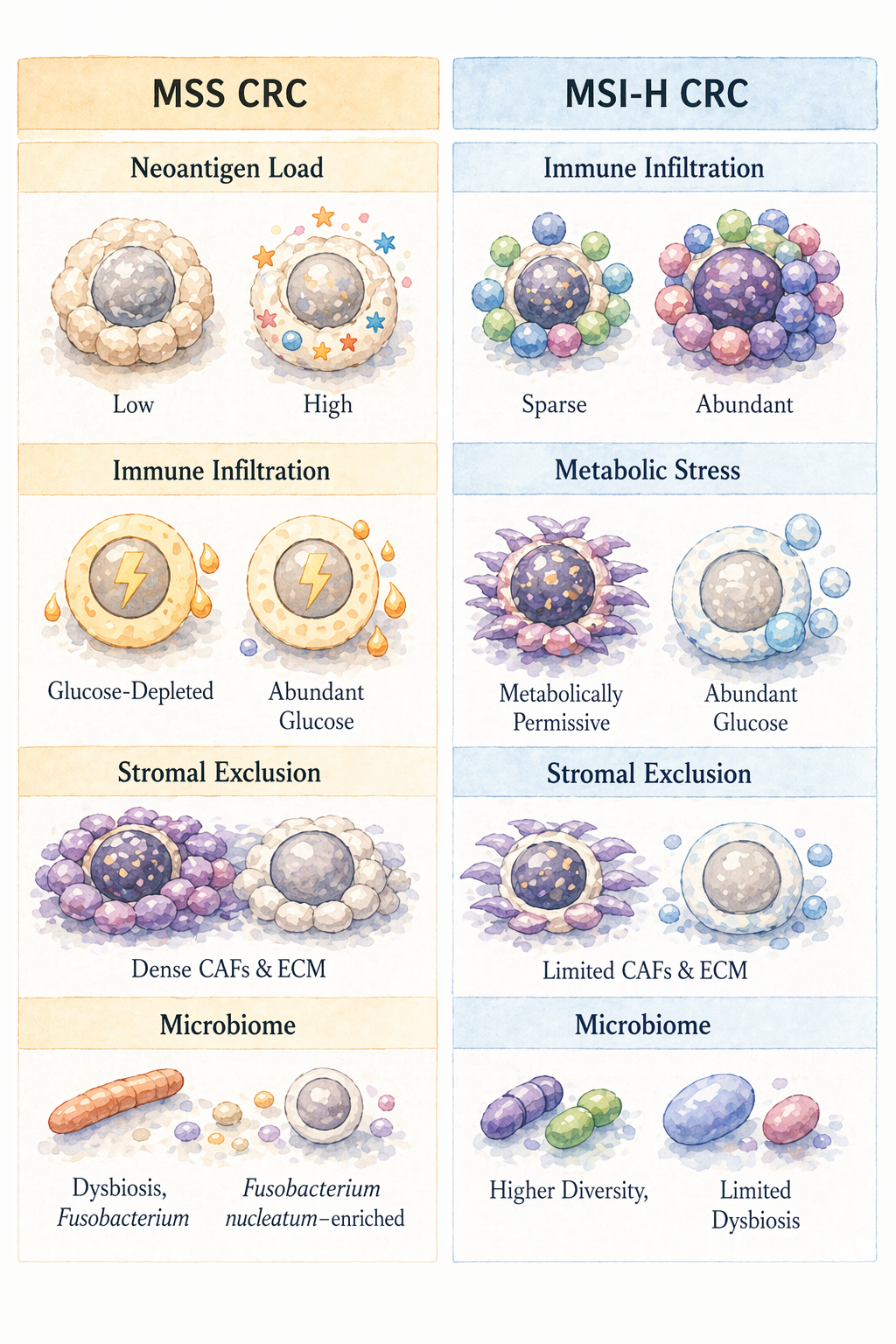
Immune checkpoint blockade (ICB) has reshaped the treatment of multiple malignancies. However, its success in colorectal cancer (CRC) has been largely restricted to the minority of tumors exhibiting microsatellite instability-high (MSI-H) status. In contrast, microsatellite-stable (MSS) colorectal cancer remains largely refractory (1, 2). For nearly a decade, this resistance has been framed in deceptively simple terms: MSS tumors are “immune cold,” lack sufficient neoantigens, and therefore fail to respond to checkpoint inhibition. While conceptually convenient, this explanation has proven clinically insufficient. MSS CRC is not immunologically barren; rather, it is immunologically constrained. This commentary examines and contextualizes the accompanying review by Mi et al. on immune resistance in MSS colorectal cancer (3). Mi and colleagues present a timely and integrative reframing of MSS CRC immune failure, arguing that resistance to ICB is driven not by immune absence per se, but by a coordinated network of metabolic, microbial, and microenvironmental constraints that actively suppress immune competence. By integrating insights from tumor immunology, immunometabolism, and microbiome research, the authors propose a tripartite model in which host metabolism, gut dysbiosis, and immune suppression form a self-reinforcing ecosystem that limits the efficacy of checkpoint blockade alone. This reframing clarifies a long-standing misconception and directly informs therapeutic strategy. The persistence of the “cold tumor” paradigm may itself have delayed progress. By attributing failure primarily to the absence of immunogenicity, the field has often underprioritized reversible ecosystem-level barriers such as nutrient deprivation, stromal exclusion, and microbial conditioning. Reframing MSS CRC as constrained rather than inert, therefore, carries not only biological significance but therapeutic urgency.
References
1. Le DT, Uram JN, Wang H, Bartlett BR, Kemberling H, Eyring AD, et al. PD-1 blockade in mismatch-repair deficiency. N Engl J Med. 2015;372(26):2509-2520. doi:10.1056/nejmoa1500596
2. Ganesh K, Stadler ZK, Cercek A, Shia J, Segal NH, Diaz LA Jr, et al. Immunotherapy in colorectal cancer: challenges and opportunities. Nat Rev Gastroenterol Hepatol. 2019;16(6):361-375. doi:10.1038/s41575-019-0126-x
3. Mi Y, Lin Z, Zhang Q, Li N, Zhang Z, Zhou H. Microbiota-Immune Crosstalk in Colorectal Cancer: Mechanisms, Metabolism, and Therapeutic Opportunities. Cancer Biome Target Ther. 2026;1(2):224-251. doi:10.66505/cbtt.v1i2.39
4. Mlecnik B, Bindea G, Angell HK, Maby P, Angelova M, Tougeron D, et al. Integrative immune analysis in colorectal cancer. Immunity. 2016;44(4):912-924. doi:10.1016/j.immuni.2016.02.025
5. Pelka K, Hofree M, Chen JH, Sarkizova S, Pirl JD, Jorgji V, et al. Spatially organized multicellular immune hubs in human colorectal cancer. Cell. 2021;184(18):4734-4752.e20. doi:10.1016/j.cell.2021.08.003
6. Keren L, Bosse M, Marquez D, Angoshtari R, Jain S, Varma S, et al. A structured tumor-immune microenvironment in triple negative breast cancer revealed by multiplexed ion beam imaging. Cell. 2018;174(6):1373-1387.e19. doi:10.1016/j.cell.2018.08.039
7. Thommen DS, Schumacher TN. T cell exhaustion in cancer. Nat Rev Immunol. 2018;18(6):409-421. doi:10.1038/s41577-018-0013-1
8. Zhang L, Yu X, Zheng L, Zhang Y, Li Y, Fang Q, et al. Lineage tracking reveals dynamic relationships of T cells in colorectal cancer. Nature. 2020;564(7735):268-272. doi:10.1038/s41586-018-0694-x
9. Ho PC, Bihuniak JD, Macintyre AN, Staron M, Liu X, Amezquita R, et al. Phosphoenolpyruvate is a metabolic checkpoint of anti-tumor T cell responses. Cell. 2015;162(6):1217-1228. doi:10.1016/j.cell.2015.08.012
10. Scharping NE, Menk AV, Moreci RS, Whetstone RD, Dadey RE, Watkins SC, et al. The tumor microenvironment represses T cell mitochondrial biogenesis to drive intratumoral T cell metabolic failure. Nat Immunol. 2021;22(3):361-374. doi:10.1038/s41590-020-00846-5
11. Sharma P, Hu-Lieskovan S, Wargo JA, Ribas A. Primary, adaptive, and acquired resistance to cancer immunotherapy. Cell. 2017;168(4):707-723. doi:10.1016/j.cell.2017.01.017
12. Buck MD, Sowell RT, Kaech SM, Pearce EL. Metabolic instruction of immunity. Cell. 2017;169(4):570-586. doi:10.1016/j.cell.2017.04.004
13. Wong SH, Yu J. Gut microbiota in colorectal cancer: mechanisms of action and clinical applications. Nat Rev Gastroenterol Hepatol. 2019;16(11):690-704. doi:10.1038/s41575-019-0209-8
14. Routy B, Le Chatelier E, Derosa L, Duong CPM, Alou MT, Daillère R, et al. Gut microbiome influences efficacy of PD-1-based immunotherapy against epithelial tumors. Science. 2018;359(6371):91-97. doi:10.1126/science.aan3706
15. Lee SH, Griffiths JR. How and why are cancers acidic? Carbonic anhydrase IX and the homeostatic control of tumour extracellular pH. Cancers (Basel). 2020;12(6):1616. doi:10.3390/cancers12061616
16. Reinfeld BI, Madden MZ, Wolf MM, Chytil A, Bader JE, Patterson AR, et al. Cell-programmed nutrient partitioning in the tumour microenvironment. Nature. 2021;593(7858):282-288. doi:10.1038/s41586-021-03442-1
17. Guinney J, Dienstmann R, Wang X, de Reyniès A, Schlicker A, Soneson C, et al. The consensus molecular subtypes of colorectal cancer. Nat Med. 2015;21(11):1350-1356. doi:10.1038/nm.3967
18. Llosa NJ, Cruise M, Tam A, Wicks EC, Hechenbleikner EM, Taube JM, et al. The vigorous immune microenvironment of microsatellite instable colon cancer is balanced by multiple counter-inhibitory checkpoints. Cancer Discov. 2015;5(1):43-51. doi:10.1158/2159-8290.CD-14-0863
19. Overman MJ, McDermott R, Leach JL, Lonardi S, Lenz HJ, Morse MA, et al. Nivolumab in patients with metastatic DNA mismatch repair-deficient or microsatellite instability-high colorectal cancer (CheckMate 142): an open-label, multicentre, phase 2 study. Lancet Oncol. 2017;18(9):1182-1191. doi:10.1016/S1470-2045(17)30422-9
20. Long GV, Dummer R, Hamid O, Gajewski TF, Caglevic C, Dalle S, et al. Epacadostat plus pembrolizumab versus pembrolizumab alone in advanced melanoma (ECHO 301/KEYNOTE 252): a phase 3 trial. Lancet Oncol. 2019;20(8):1083-1097. doi:10.1016/S1470-2045(19)30274-8
21. Kraman M, Bambrough PJ, Arnold JN, Roberts EW, Magiera L, Jones JO, et al. Suppression of antitumor immunity by stromal cells expressing fibroblast activation protein α. Science. 2010;330(6005):827-830. doi:10.1126/science.1195300
22. Schürch CM, Bhate SS, Barlow GL, Phillips DJ, Noti L, Zlobec I, et al. Coordinated cellular neighborhoods orchestrate antitumoral immunity at the colorectal cancer invasive front. Cell. 2020;182(5):1341-1359.e19. doi:10.1016/j.cell.2020.07.005
23. Gopalakrishnan V, Spencer CN, Nezi L, Reuben A, Andrews MC, Karpinets TV, et al. Gut microbiome modulates response to anti-PD-1 immunotherapy in melanoma patients. Science. 2018;359(6371):97-103. doi:10.1126/science.aan4236
Published
How to Cite
Issue
Section
License
Copyright (c) 2026 Christophe Nicot

This work is licensed under a Creative Commons Attribution 4.0 International License.
Copyright
Authors publishing in Cancer Biome and Targeted Therapy retain full copyright of their work. By submitting a manuscript, authors grant the publisher (GCINC Press) a non-exclusive license to publish, distribute, and archive the article, and to identify itself as the original publisher.
License
All articles are published open access under the terms of the Creative Commons Attribution 4.0 International License (CC BY 4.0).
https://creativecommons.org/licenses/by/4.0/. This license permits unrestricted use, distribution, reproduction, and adaptation in any medium, including for commercial purposes, provided that:
- Proper attribution is given to the original author(s) and source,
- A link to the license is provided, and
- Any changes made are clearly indicated.
Author Rights
Authors retain the right to:
- Use their article in future works (e.g., books, theses, lectures)
- Share and archive the final published version on institutional repositories or personal websites
- Adapt or translate their work, or authorize others to do so, with proper citation
Reuse by Third Parties
Content is licensed under the Creative Commons Attribution 4.0 International License (CC BY 4.0). Third parties may copy, redistribute, remix, transform, and build upon the material for any purpose, including commercial use, provided that appropriate credit is given to the original author(s).
Archiving and Preservation
All articles are made freely available immediately upon publication, without embargo. Cancer Biome and Targeted Therapy is hosted on the Open Journal Systems (OJS) platform, developed by the Public Knowledge Project (PKP). The journal participates in long-term digital preservation through the PKP Preservation Network (PKP PN) using the LOCKSS system. Authors are encouraged to self-archive in institutional repositories, disciplinary archives, and preprint servers in accordance with the license terms.




Funding data
-
Center for Cancer Research
Grant numbers P30CA168524