The Gut Microbiome and Colorectal Cancer: From Association to Causation
DOI:
https://doi.org/10.66505/cbtt.v1i2.40Keywords:
colorectal cancer, gut microbiome, Fusobacterium nucleatum, tumor microenvironment, immunotherapy sensitivity, microbiome-based biomarkersAbstract
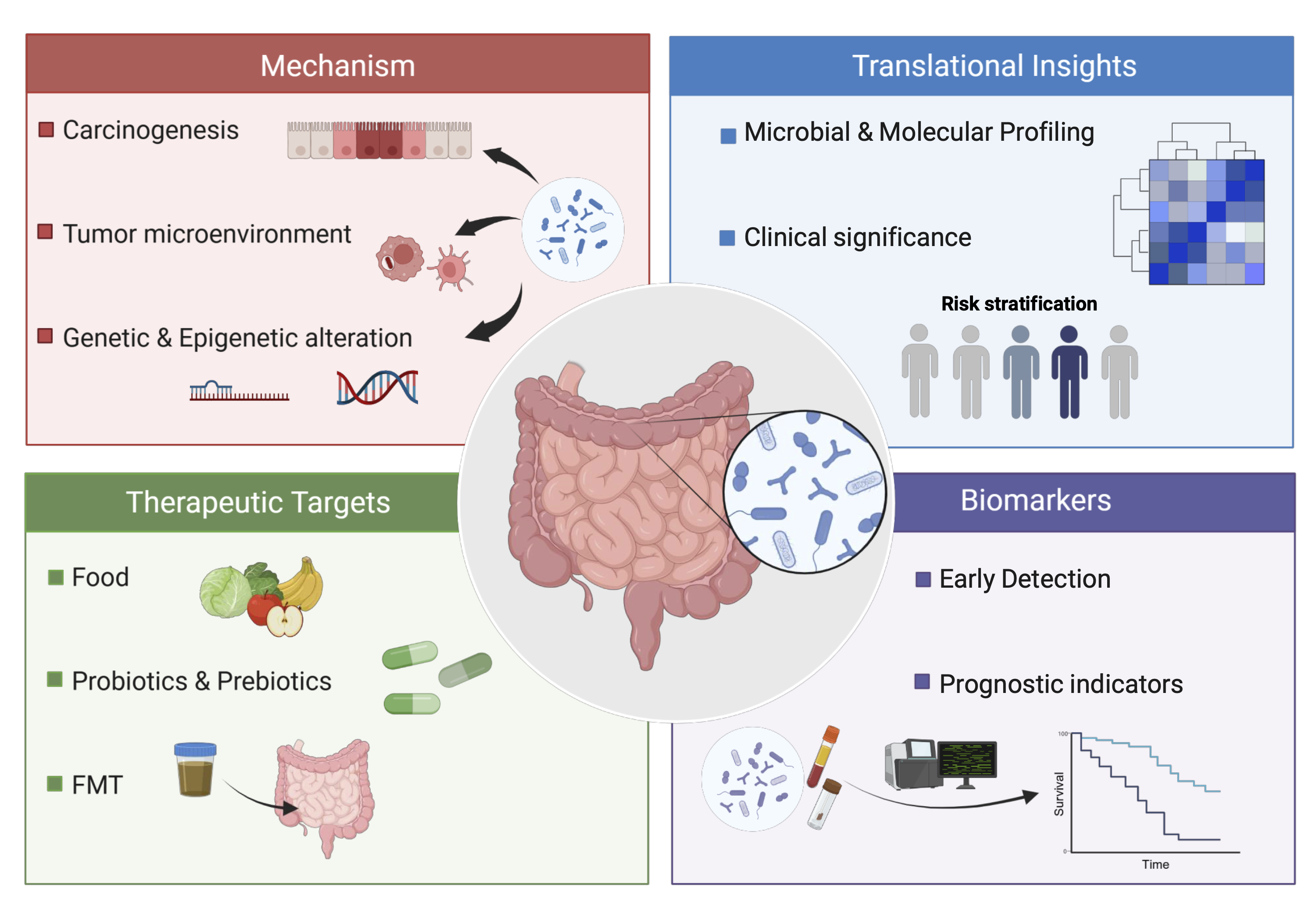
This mini-review discusses the emerging role of the gut microbiome as an active driver of colorectal cancer initiation, progression, and therapeutic response. Key mechanisms include microbiome-induced genomic instability, modulation of host immune responses, and epigenetic reprogramming mediated by tumor-associated bacteria such as Fusobacterium nucleatum. Emerging evidence suggests that specific microbial signatures are not only associated with disease but can functionally shape tumor behavior, influence treatment sensitivity, and serve as clinically actionable biomarkers. These insights highlight the potential of integrating microbiome profiling into precision oncology and underscore the need for mechanistic and translational studies to harness host–microbe interactions for improved cancer prevention and therapy.
References
1. Charbonneau MR, Blanton LV, DiGiulio DB, Relman DA, Lebrilla CB, Mills DA, et al. A microbial perspective of human developmental biology. Nature. 2016;535(7610):48-55. doi:10.1038/nature18845
2. Lynch SV, Pedersen O. The human intestinal microbiome in health and disease. N Engl J Med. 2016;375(24):2369-2379. doi:10.1056/nejmra1600266
3. Marchesi JR, Adams DH, Fava F, Hermes GDA, Hirschfield GM, Hold G, et al. The gut microbiota and host health: a new clinical frontier. Gut. 2016;65(2):330-339. doi:10.1136/gutjnl-2015-309990
4. Xu C, Fan L, Lin Y, Shen W, Qi Y, Zhang Y, et al. Fusobacterium nucleatum promotes colorectal cancer metastasis through miR-1322/CCL20 axis and M2 polarization. Gut Microbes. 2021;13(1):1980347. doi:10.1080/19490976.2021.1980347
5. Drewes JL, Housseau F, Sears CL. Sporadic colorectal cancer: microbial contributors to disease prevention, development and therapy. Br J Cancer. 2016;115(3):273-280. doi:10.1038/bjc.2016.189
6. Li Q, Xiao Y, Han L, Luo W, Dai W, Fang H, et al. Microbiome dysbiosis, neutrophil recruitment and mesenchymal transition of mesothelial cells promotes peritoneal metastasis of colorectal cancer. Nat Cancer. 2025;6(3):493-510. doi:10.1038/s43018-025-00910-9
7. Jans M, Vereecke L. Physiological drivers of pks+ E. coli in colorectal cancer. Trends Microbiol. 2025;33(9):1003-1017. doi:10.1016/j.tim.2025.04.010
8. Dougherty MW, Jobin C. Intestinal bacteria and colorectal cancer: etiology and treatment. Gut Microbes. 2023;15(1):2185028. doi:10.1080/19490976.2023.2185028
9. Wang Q, Hu T, Zhang Q, Zhang Y, Dong X, Jin Y, et al. Fusobacterium nucleatum promotes colorectal cancer through neogenesis of tumor stem cells. J Clin Invest. 2025;135(3):e181595. doi:10.1172/jci181595
10. Yang Y, Weng W, Peng J, Hong L, Yang L, Toiyama Y, et al. Fusobacterium nucleatum increases proliferation of colorectal cancer cells and tumor development in mice by activating Toll-like receptor 4 signaling to nuclear factor κB and up-regulating expression of microRNA 21. Gastroenterology. 2017;152(4):851-866.e24. doi:10.1053/j.gastro.2016.11.018
11. Kostic AD, Chun E, Robertson L, Fuchs CS, Meyerson M, Garrett WS. Fusobacterium nucleatum potentiates intestinal tumorigenesis and modulates the tumor immune microenvironment. Cell Host Microbe. 2013;14(2):207-215. doi:10.1016/j.chom.2013.07.007
12. Mima K, Nishihara R, Qian ZR, Cao Y, Sukawa Y, Nowak JA, et al. Fusobacterium nucleatum in colorectal carcinoma tissue and patient prognosis. Gut. 2016;65(12):1973-1980. doi:10.1136/gutjnl-2015-310101
13. Tahara T, Yamamoto E, Suzuki H, Maruyama R, Chung W, Garriga J, et al. Fusobacterium in colonic flora and molecular features of colorectal carcinoma. Cancer Res. 2014;74(5):1311-1318. doi:10.1158/0008-5472.can-13-1865
14. Zepeda-Rivera M, Minot SS, Bouzek H, Wu H, Blanco-Miguez A, Manghi P, et al. A distinct Fusobacterium nucleatum clade dominates the colorectal cancer niche. Nature. 2024;628(8007):424-432. doi:10.1038/s41586-024-07182-w
15. Rubinstein MR, Wang X, Liu W, Hao Y, Cai G, Han YW. Fusobacterium nucleatum promotes colorectal carcinogenesis by modulating E-cadherin/β-catenin signaling via its FadA adhesin. Cell Host Microbe. 2013;14(2):195-206. doi:10.1016/j.chom.2013.07.012
16. Galeano Niño JL, Ponath F, Ajisafe VA, Becker CR, Kempchinsky AG, Zepeda-Rivera MA, et al. Tumor-infiltrating bacteria disrupt cancer epithelial cell interactions and induce cell-cycle arrest. Cancer Cell. 2026;44(1):166-186.e16. doi:10.1016/j.ccell.2025.09.010
17. Jiang SS, Xie YL, Xiao XY, Kang ZR, Lin XL, Zhang L, et al. Fusobacterium nucleatum-derived succinic acid induces tumor resistance to immunotherapy in colorectal cancer. Cell Host Microbe. 2023;31(5):781-797.e9. doi:10.1016/j.chom.2023.04.010
18. Wang M, Rousseau B, Qiu K, Huang G, Zhang Y, Su H, et al. Killing tumor-associated bacteria with a liposomal antibiotic generates neoantigens that induce anti-tumor immune responses. Nat Biotechnol. 2024;42(8):1263-1274. doi:10.1038/s41587-023-01957-8
19. Wang X, Fang Y, Liang W, Wong CC, Qin H, Gao Y, et al. Fusobacterium nucleatum facilitates anti-PD-1 therapy in microsatellite stable colorectal cancer. Cancer Cell. 2024;42(10):1729-1746.e8. doi:10.1016/j.ccell.2024.08.019
20. Takahashi K, Shigeyasu K, Kondo Y, Gotoh K, Yano S, Umeda Y, et al. RNA editing is a valuable biomarker for predicting carcinogenesis in ulcerative colitis. J Crohns Colitis. 2023;17(5):754-766. doi:10.1093/ecco-jcc/jjac186
21. Guo S, Chen J, Chen F, Zeng Q, Liu WL, Zhang G. Exosomes derived from Fusobacterium nucleatum-infected colorectal cancer cells facilitate tumour metastasis by selectively carrying miR-1246/92b-3p/27a-3p and CXCL16. Gut. 2020;69(5):772-784. doi:10.1136/gutjnl-2020-321187
22. Park PH, Keith K, Calendo G, Jelinek J, Madzo J, Gharaibeh RZ, et al. Association between gut microbiota and CpG island methylator phenotype in colorectal cancer. Gut Microbes. 2024;16(1):2363012. doi:10.1080/19490976.2024.2363012
23. Takeda S, Shigeyasu K, Okugawa Y, Yoshida K, Mori Y, Yano S, et al. Activation of AZIN1 RNA editing is a novel mechanism that promotes invasive potential of cancer-associated fibroblasts in colorectal cancer. Cancer Lett. 2019;444:127-135. doi:10.1016/j.canlet.2018.12.009
24. Shigeyasu K, Okugawa Y, Toden S, Miyoshi J, Toiyama Y, Nagasaka T, et al. AZIN1 RNA editing confers cancer stemness and enhances oncogenic potential in colorectal cancer. JCI Insight. 2018;3(12):e99976. doi:10.1172/jci.insight.99976
25. Ju CW, Lyu R, Li H, Wei J, Parra Vitela AJ, Dougherty U, et al. Modifications of microbiome-derived cell-free RNA in plasma discriminate colorectal cancer samples. Nat Biotechnol. 2025. Epub ahead of print. doi:10.1038/s41587-025-02731-8
26. Yi Y, Shen L, Shi W, Xia F, Zhang H, Wang Y, et al. Gut microbiome components predict response to neoadjuvant chemoradiotherapy in patients with locally advanced rectal cancer: a prospective, longitudinal study. Clin Cancer Res. 2021;27(5):1329-1340. doi:10.1158/1078-0432.ccr-20-3445
27. Tito RY, Verbandt S, Aguirre Vazquez M, Lathi L, Verspecht C, Lloréns-Rico V, et al. Microbiome confounders and quantitative profiling challenge predicted microbial targets in colorectal cancer development. Nat Med. 2024;30(5):1339-1348. doi:10.1038/s41591-024-02963-2
Published
How to Cite
Issue
Section
License
Copyright (c) 2026 Ajay Goel, Toshiaki Takahashi

This work is licensed under a Creative Commons Attribution 4.0 International License.
Copyright
Authors publishing in Cancer Biome and Targeted Therapy retain full copyright of their work. By submitting a manuscript, authors grant the publisher (GCINC Press) a non-exclusive license to publish, distribute, and archive the article, and to identify itself as the original publisher.
License
All articles are published open access under the terms of the Creative Commons Attribution 4.0 International License (CC BY 4.0).
https://creativecommons.org/licenses/by/4.0/. This license permits unrestricted use, distribution, reproduction, and adaptation in any medium, including for commercial purposes, provided that:
- Proper attribution is given to the original author(s) and source,
- A link to the license is provided, and
- Any changes made are clearly indicated.
Author Rights
Authors retain the right to:
- Use their article in future works (e.g., books, theses, lectures)
- Share and archive the final published version on institutional repositories or personal websites
- Adapt or translate their work, or authorize others to do so, with proper citation
Reuse by Third Parties
Content is licensed under the Creative Commons Attribution 4.0 International License (CC BY 4.0). Third parties may copy, redistribute, remix, transform, and build upon the material for any purpose, including commercial use, provided that appropriate credit is given to the original author(s).
Archiving and Preservation
All articles are made freely available immediately upon publication, without embargo. Cancer Biome and Targeted Therapy is hosted on the Open Journal Systems (OJS) platform, developed by the Public Knowledge Project (PKP). The journal participates in long-term digital preservation through the PKP Preservation Network (PKP PN) using the LOCKSS system. Authors are encouraged to self-archive in institutional repositories, disciplinary archives, and preprint servers in accordance with the license terms.




Funding data
-
Center for Cancer Research
Grant numbers CA181572; CA184792; CA187956; CA214254; CA271443; CA296639