Microbiota-Immune Crosstalk in Colorectal Cancer: Mechanisms, Metabolism, and Therapeutic Opportunities
DOI:
https://doi.org/10.66505/cbtt.v1i2.39Keywords:
microsatellite-stable colorectal cancer, immune checkpoint blockade, tumor microenvironment, immunometabolism, gut microbiome, metabolic reprogramming, microbial metabolites, immunotherapy resistanceAbstract
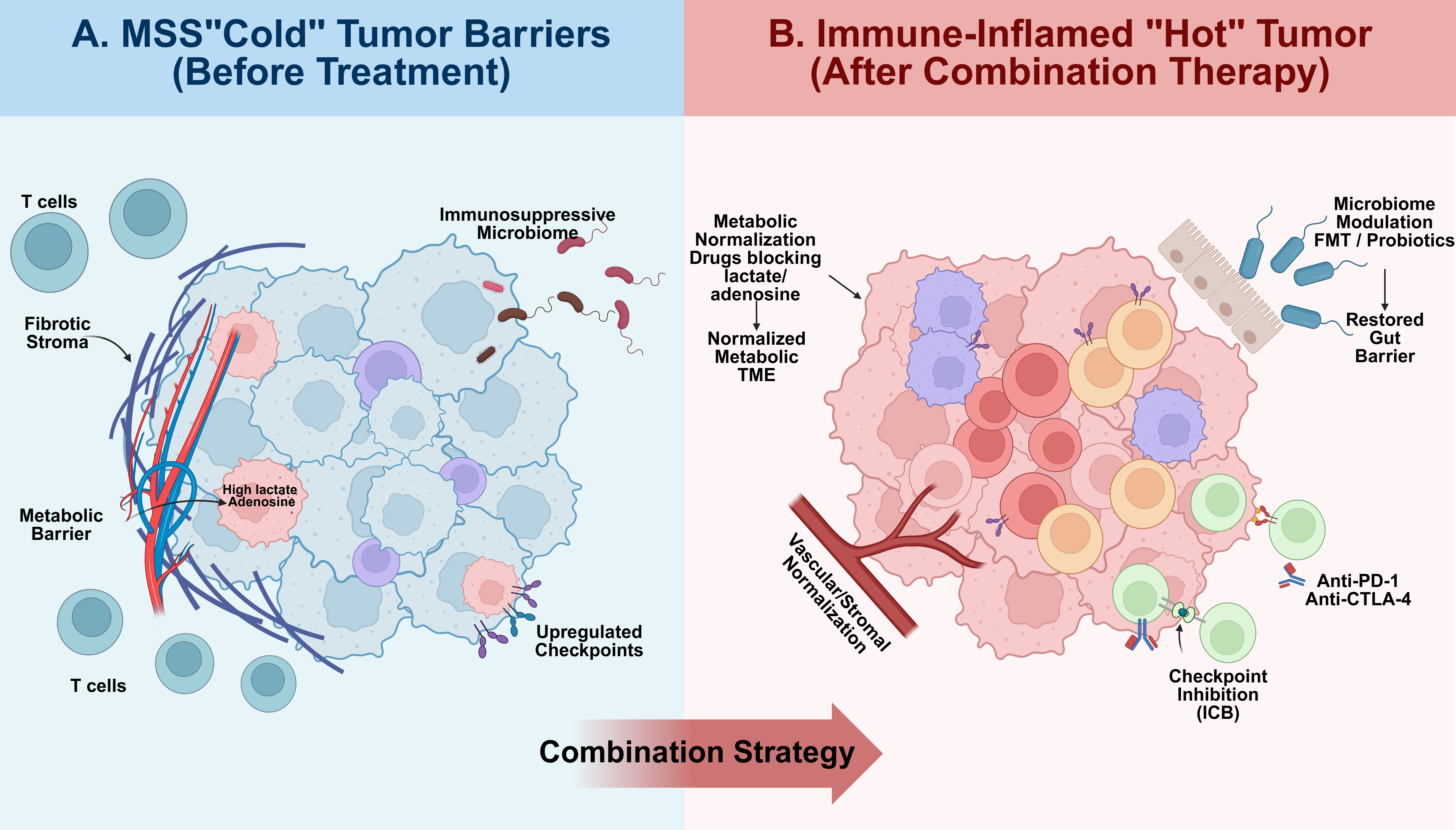
Microsatellite-stable (MSS) colorectal cancer (CRC) makes up most CRC cases but remains mostly resistant to immune checkpoint blockade (ICB), unlike the durable responses seen in microsatellite instability–high tumors. Increasing evidence indicates that resistance in MSS CRC stems not only from a lack of immune cells but also from complex constraints imposed by the tumor environment. Here, we review recent progress and introduce an immunometabolic barrier model in which tumor metabolic reprogramming, gut microbial imbalance, and immune suppression create mutually reinforcing resistance circuits. Processes like aerobic glycolysis, hypoxia, and nutrient competition produce lactate-rich, glucose-poor areas that impair cytotoxic T and NK cell activity while promoting regulatory T cells and suppressive myeloid cells. Meanwhile, CRC-related microbial imbalance damages barrier integrity and alters metabolite signaling, thereby enhancing inflammatory and inhibitory pathways, including adenosine and kynurenine–aryl hydrocarbon receptor signaling. These combined mechanisms lead to a metabolically restricted and immunologically “cold” tumor microenvironment, reducing the effectiveness of ICB alone. We believe that overcoming MSS resistance will require reprogramming the entire ecosystem by combining immunotherapy with metabolic and microbiome-targeted strategies guided by spatial and multi-omic biomarkers. Therefore, MSS CRC should be seen not just as a genetic subtype but as a dynamic state of immune resistance within the tumor ecosystem.
References
1. Karam F, El Deghel Y, Iratni R, Dakroub AH, Eid AH. The gut microbiome and colorectal cancer: an integrative review of the underlying mechanisms. Cell Biochem Biophys. 2025;83(3):2637-2650. doi:10.1007/s12013-025-01683-9
2. Sung H, Ferlay J, Siegel RL, Laversanne M, Soerjomataram I, Jemal A, et al. Global cancer statistics 2020: GLOBOCAN estimates of incidence and mortality worldwide for 36 cancers in 185 countries. CA Cancer J Clin. 2021;71(3):209-249. doi:10.3322/caac.21660
3. Siegel RL, Wagle NS, Cercek A, Smith RA, Jemal A. Colorectal cancer statistics, 2023. CA Cancer J Clin. 2023;73(3):233-254. doi:10.3322/caac.21772
4. Hofseth LJ, Hebert JR, Chanda A, Chen H, Love BL, Pena MM, et al. Early-onset colorectal cancer: initial clues and current views. Nat Rev Gastroenterol Hepatol. 2020;17(6):352-364. doi:10.1038/s41575-019-0253-4
5. The Cancer Genome Atlas Network. Comprehensive molecular characterization of human colon and rectal cancer. Nature. 2012;487(7407):330-337. doi:10.1038/nature11252
6. Roudko V, Bozkus CC, Orfanelli T, McClain CB, Carr C, O'Donnell T, et al. Shared immunogenic poly-epitope frameshift mutations in microsatellite unstable tumors. Cell. 2020;183(6):1634-1649.e17. doi:10.1016/j.cell.2020.11.004
7. Yan S, Wang W, Feng Z, Xue J, Liang W, Wu X, et al. Immune checkpoint inhibitors in colorectal cancer: limitation and challenges. Front Immunol. 2024;15:1403533. doi:10.3389/fimmu.2024.1403533
8. Le DT, Uram JN, Wang H, Bartlett BR, Kemberling H, Eyring AD, et al. PD-1 blockade in tumors with mismatch-repair deficiency. N Engl J Med. 2015;372(26):2509-2520. doi:10.1056/nejmoa1500596
9. Rahimi A, Baghernejadan Z, Hazrati A, Malekpour K, Samimi LN, Najafi A, et al. Combination therapy with immune checkpoint inhibitors in colorectal cancer: Challenges, resistance mechanisms, and the role of microbiota. Biomed Pharmacother. 2025;186:118014. doi:10.1016/j.biopha.2025.118014
10. Galon J, Costes A, Sanchez-Cabo F, Kirilovsky A, Mlecnik B, Lagorce-Pages C, et al. Type, density, and location of immune cells within human colorectal tumors predict clinical outcome. Science. 2006;313(5795):1960-1964. doi:10.1126/science.1129139
11. Almquist DR, Ahn DH, Bekaii-Saab TS. The role of immune checkpoint inhibitors in colorectal adenocarcinoma. BioDrugs. 2020;34(3):349-362. doi:10.1007/s40259-020-00420-3
12. Sahin IH, Saridogan T, Kim R. Predictive biomarkers for immune checkpoint inhibition for patients with colorectal cancer: a comprehensive review. Immunotherapy. 2025;17(10):727-734. doi:10.1080/1750743x.2025.2530853
13. Tauriello DVF, Palomo-Ponce S, Stork D, Berenguer-Llergo A, Badia-Ramentol J, Iglesias M, et al. TGFβ drives immune evasion in genetically reconstituted colon cancer metastasis. Nature. 2018;554(7693):538-543. doi:10.1038/nature25492
14. Nenkov M, Ma Y, Gassler N, Chen Y. Metabolic Reprogramming of Colorectal Cancer Cells and the Microenvironment: Implication for Therapy. Int J Mol Sci. 2021;22(12):6262. doi:10.3390/ijms22126262
15. Zhang Z, Hu Y, Chen Y, Chen Z, Zhu Y, Chen M, et al. Immunometabolism in the tumor microenvironment and its related research progress. Front Oncol. 2022;12:1024789. doi:10.3389/fonc.2022.1024789
16. Chang CH, Qiu J, O'Sullivan D, Buck MD, Noguchi T, Curtis JD, et al. Metabolic competition in the tumor microenvironment is a driver of cancer progression. Cell. 2015;162(6):1229-1241. doi:10.1016/j.cell.2015.08.016
17. Hanus M, Parada-Venegas D, Landskron G, Wielandt AM, Hurtado C, Alvarez K, et al. Immune system, microbiota, and microbial metabolites: the unresolved triad in colorectal cancer microenvironment. Front Immunol. 2021;12:612826. doi:10.3389/fimmu.2021.612826
18. Roy DG, Kaymak I, Williams KS, Ma EH, Jones RG. Immunometabolism in the tumor microenvironment. Annu Rev Cancer Biol. 2021;5:137-159. doi:10.1146/annurev-cancerbio-030518-055817
19. Guo C, Chen S, Liu W, Ma Y, Li J, Fisher PB, et al. Immunometabolism: a new target for improving cancer immunotherapy. Adv Cancer Res. 2019;143:195-253. doi:10.1016/bs.acr.2019.03.004
20. Angelin A, Gil-de-Gomez L, Dahiya S, Jiao J, Guo L, Levine MH, et al. Foxp3 reprograms T cell metabolism to function in low-glucose, high-lactate environments. Cell Metab. 2017;25(6):1282-1293.e7. doi:10.1016/j.cmet.2016.12.018
21. Mager LF, Burkhard R, Pett N, Cooke NCA, Brown K, Ramay H, et al. Microbiome-derived inosine modulates response to checkpoint inhibitor immunotherapy. Science. 2020;369(6510):1481-1489. doi:10.1126/science.abc3421
22. Kaymak I, Williams KS, Cantor JR, Jones RG. Immunometabolic interplay in the tumor microenvironment. Cancer Cell. 2021;39(1):28-37. doi:10.1016/j.ccell.2020.09.004
23. Wherry EJ, Kurachi M. Molecular and cellular insights into T cell exhaustion. Nat Rev Immunol. 2015;15(8):486-499. doi:10.1038/nri3862
24. Zhang L, Yu X, Zheng L, Zhang Y, Li Y, Fang Q, et al. Lineage tracking reveals dynamic relationships of T cells in colorectal cancer. Nature. 2018;564(7735):268-272. doi:10.1038/s41586-018-0694-x
25. Zhou Y, Han W, Feng Y, Wang Y, Sun T, Xu J. Microbial metabolites affect tumor progression, immunity and therapy prediction by reshaping the tumor microenvironment (Review). Int J Oncol. 2024;65(1):73. doi:10.3892/ijo.2024.5661
26. Li X, Jia Y, Li Y, Hei H, Zhang S, Qin J. Crosstalk between metabolic reprogramming and microbiota: implications for cancer progression and novel therapeutic opportunities. Front Immunol. 2025;16:1582166. doi:10.3389/fimmu.2025.1582166
27. Grivennikov SI, Wang K, Mucida D, Stewart CA, Schnabl B, Jauch D, et al. Adenoma-linked barrier defects and microbial products drive IL-23/IL-17-mediated tumour growth. Nature. 2012;491(7423):254-258. doi:10.1038/nature11465
28. Wu S, Rhee KJ, Albesiano E, Rabizadeh S, Wu X, Yen HR, et al. A human colonic commensal promotes colon tumorigenesis via activation of T helper type 17 T cell responses. Nat Med. 2009;15(9):1016-1022. doi:10.1038/nm.2015
29. Yang H, Zhang Z, Li J, Wang K, Zhu W, Zeng Y. The dual role of B cells in the tumor microenvironment: implications for cancer immunology and therapy. Int J Mol Sci. 2024;25(21):11825. doi:10.3390/ijms252111825
30. Karimova AF, Khalitova AR, Suezov R, Markov N, Mukhamedshina Y, Rizvanov AA, et al. Immunometabolism of tumor-associated macrophages: A therapeutic perspective. Eur J Cancer. 2025;220:115332. doi:10.1016/j.ejca.2025.115332
31. Tanaka A, Sakaguchi S. Regulatory T cells in cancer immunotherapy. Cell Res. 2017;27(1):109-118. doi:10.1038/cr.2016.151
32. Zhang C, Wang Y, Cheng L, Cao X, Liu C. Gut microbiota in colorectal cancer: a review of its influence on tumor immune surveillance and therapeutic response. Front Oncol. 2025;15:1557959. doi:10.3389/fonc.2025.1557959
33. Edin S, Kaprio T, Hagstrom J, Larsson P, Mustonen H, Bockelman C, et al. The prognostic importance of CD20+ B lymphocytes in colorectal cancer and the relation to other immune cell subsets. Sci Rep. 2019;9(1):19997. doi:10.1038/s41598-019-56441-8
34. Helmink BA, Reddy SM, Gao J, Zhang S, Basar R, Thakur R, et al. B cells and tertiary lymphoid structures promote immunotherapy response. Nature. 2020;577(7791):549-555. doi:10.1038/s41586-019-1922-8
35. Cabrita R, Lauss M, Sanna A, Donia M, Skaarup Larsen M, Mitra S, et al. Tertiary lymphoid structures improve immunotherapy and survival in melanoma. Nature. 2020;577(7791):561-565. doi:10.1038/s41586-019-1914-8
36. Posch F, Silina K, Leibl S, Mundlein A, Moch H, Siebenhuner A, et al. Maturation of tertiary lymphoid structures and recurrence of stage II and III colorectal cancer. Oncoimmunology. 2018;7(2):e1378844. doi:10.1080/2162402x.2017.1378844
37. Rosser EC, Mauri C. Regulatory B cells: origin, phenotype, and function. Immunity. 2015;42(4):607-612. doi:10.1016/j.immuni.2015.04.005
38. Jiang S, Feng R, Tian Z, Zhou J, Zhang W. Metabolic dialogs between B cells and the tumor microenvironment: Implications for anticancer immunity. Cancer Lett. 2023;556:216076. doi:10.1016/j.canlet.2023.216076
39. Xiao Z, Wang R, Wang X, Yang H, Dong J, He X, et al. Impaired function of dendritic cells within the tumor microenvironment. Front Immunol. 2023;14:1213629. doi:10.3389/fimmu.2023.1213629
40. Miao Y, Liu Y, Tang H, Zhang Z. Dendritic cell maturation in the tumor microenvironment. Natl Sci Open. 2023;2(6):20220053. doi:10.1360/nso/20220053
41. Peng X, He Y, Huang J, Tao Y, Liu S. Metabolism of dendritic cells in tumor microenvironment: for immunotherapy. Front Immunol. 2021;12:613492. doi:10.3389/fimmu.2021.613492
42. Sieminska I, Baran J. Myeloid-derived suppressor cells in colorectal cancer. Front Immunol. 2020;11:1526. doi:10.3389/fimmu.2020.01526
43. Singer K, Cheng WC, Kreutz M, Ho PC, Siska PJ. Immunometabolism in cancer at a glance. Dis Model Mech. 2018;11(8):dmm034272. doi:10.1242/dmm.034272
44. Chambers AM, Lupo KB, Matosevic S. Tumor microenvironment-induced immunometabolic reprogramming of natural killer cells. Front Immunol. 2018;9:2517. doi:10.3389/fimmu.2018.02517
45. Bodac A, Meylan E. Neutrophil metabolism in the cancer context. Semin Immunol. 2021;57:101583. doi:10.1016/j.smim.2021.101583
46. Wang M, Qu L, Du X, Song P, Ng JPL, Wong VKW, et al. Natural products and derivatives targeting metabolic reprogramming in colorectal cancer: a comprehensive review. Metabolites. 2024;14(9):490. doi:10.3390/metabo14090490
47. Zhang J, Zou S, Fang L. Metabolic reprogramming in colorectal cancer: regulatory networks and therapy. Cell Biosci. 2023;13(1):25. doi:10.1186/s13578-023-00977-w
48. Satoh K, Yachida S, Sugimoto M, Oshima M, Nakagawa T, Akamoto S, et al. Global metabolic reprogramming of colorectal cancer occurs at adenoma stage and is induced by MYC. Proc Natl Acad Sci U S A. 2017;114(37):E7697-E7706. doi:10.1073/pnas.1710366114
49. Patra KC, Hay N. The pentose phosphate pathway and cancer. Trends Biochem Sci. 2014;39(8):347-354. doi:10.1016/j.tibs.2014.06.005
50. Jin L, Zhou Y. Crucial role of the pentose phosphate pathway in malignant tumors. Oncol Lett. 2019;17(5):4213-4221. doi:10.3892/ol.2019.10112
51. Gu XY, Yang JL, Lai R, Zhou ZJ, Tang D, Hu L, et al. Impact of lactate on immune cell function in the tumor microenvironment: mechanisms and therapeutic perspectives. Front Immunol. 2025;16:1563303. doi:10.3389/fimmu.2025.1563303
52. Brand A, Singer K, Koehl GE, Kolitzus M, Schoenhammer G, Thiel A, et al. LDHA-associated lactic acid production blunts tumor immunosurveillance by T and NK cells. Cell Metab. 2016;24(5):657-671. doi:10.1016/j.cmet.2016.08.011
53. Li C, Jiang X, Yuan Y, Wang Q. Lactylation and tumor immune regulation: insights from recent studies. Front Immunol. 2025;16:1699314. doi:10.3389/fimmu.2025.1699314
54. Wei J, Ding Q, Wang H, Liu Y. Lactylation in digestive system tumors: from mechanisms to therapeutic target. Front Oncol. 2025;15:1607249. doi:10.3389/fonc.2025.1607249
55. Leone RD, Zhao L, Englert JM, Sun IM, Oh MH, Sun IH, et al. Glutamine blockade induces divergent metabolic programs to overcome tumor immune evasion. Science. 2019;366(6468):1013-1021. doi:10.1126/science.aav2588
56. Antonov A, Agostini M, Morello M, Minieri M, Melino G, Amelio I. Bioinformatics analysis of the serine and glycine pathway in cancer cells. Oncotarget. 2014;5(22):11004-1113. doi:10.18632/oncotarget.2668
57. Pan S, Fan M, Liu Z, Li X, Wang H. Serine, glycine and one-carbon metabolism in cancer (Review). Int J Oncol. 2021;58(2):158-170. doi:10.3892/ijo.2020.5158
58. Geiger R, Rieckmann JC, Wolf T, Basso C, Feng Y, Fuhrer T, et al. L-arginine modulates T cell metabolism and enhances survival and anti-tumor activity. Cell. 2016;167(3):829-842.e13. doi:10.1016/j.cell.2016.09.031
59. Zha J, Cang P, Zhong Y, Liu R, Fan G. The role and mechanism of abnormal lipid metabolism in colorectal cancer. Sci Prog. 2025;108(3):368504251368237. doi:10.1177/00368504251368237
60. Zhuang Z, Chen Y, Yao Y, Zhu X. Metabolic reprogramming in colorectal cancer: the impact of fatty acid metabolism. Hum Mutat. 2025;2025:9567214. doi:10.1155/humu/9567214
61. Michalek RD, Gerriets VA, Jacobs SR, Macintyre AN, MacIver NJ, Mason EF, et al. Cutting edge: distinct glycolytic and lipid oxidative metabolic programs are essential for effector and regulatory CD4+ T cell subsets. J Immunol. 2011;186(6):3299-3303. doi:10.4049/jimmunol.1003613
62. Wang H, Franco F, Tsui YC, Xie X, Trefny MP, Zappasodi R, et al. CD36-mediated metabolic adaptation supports regulatory T cell survival and function in tumors. Nat Immunol. 2020;21(3):298-308. doi:10.1038/s41590-019-0589-5
63. Pandey P, Lakhanpal S, Mahmood D, Baldaniya L, Kang HN, Hwang S, et al. Recent update of natural compounds as HIF-1alpha inhibitors in colorectal carcinoma. Drug Des Devel Ther. 2025;19:2017-2034. doi:10.2147/dddt.s511406
64. Gong L, Zhang H, Liu Y, Wang X, Xia R. Interactions between non-coding RNAs and HIF-1alpha in the context of colorectal cancer. Biomolecules. 2025;15(4):510. doi:10.3390/biom15040510
65. Noman MZ, Desantis G, Janji B, Hasmim M, Karray S, Dessen P, et al. PD-L1 is a novel direct target of HIF-1α, and its blockade under hypoxia enhanced MDSC-mediated T cell activation. J Exp Med. 2014;211(5):781-790. doi:10.1084/jem.20131916
66. Ohta A, Gorelik E, Prasad SJ, Ronchese F, Lukashev D, Wong MK, et al. A2A adenosine receptor protects tumors from antitumor T cells. Proc Natl Acad Sci U S A. 2006;103(35):13132-13137. doi:10.1073/pnas.0605251103
67. Stine ZE, Walton ZE, Altman BJ, Hsieh AL, Dang CV. MYC, metabolism, and cancer. Cancer Discov. 2015;5(10):1024-1039. doi:10.1158/2159-8290.cd-15-0507
68. Yun J, Rago C, Cheong I, Pagliarini R, Angenendt P, Rajagopalan H, et al. Glucose deprivation contributes to the development of KRAS pathway mutations in tumor cells. Science. 2009;325(5947):1555-1559. doi:10.1126/science.1174229
69. Bensaad K, Tsuruta A, Selak MA, Vidal MN, Nakano K, Bartrons R, et al. TIGAR, a p53-inducible regulator of glycolysis and apoptosis. Cell. 2006;126(1):107-120. doi:10.1016/j.cell.2006.05.036
70. Liu Y, Lau HC, Cheng WY, Yu J. Gut microbiome in colorectal cancer: clinical diagnosis and treatment. Genomics Proteomics Bioinformatics. 2023;21(1):84-96. doi:10.1016/j.gpb.2022.07.002
71. Greten FR, Grivennikov SI. Inflammation and cancer: triggers, mechanisms, and consequences. Immunity. 2019;51(1):27-41. doi:10.1016/j.immuni.2019.06.025
72. Rubinstein MR, Wang X, Liu W, Hao Y, Cai G, Han YW. Fusobacterium nucleatum promotes colorectal carcinogenesis by modulating E-cadherin/beta-catenin signaling via its FadA adhesin. Cell Host Microbe. 2013;14(2):195-206. doi:10.1016/j.chom.2013.07.012
73. Pleguezuelos-Manzano C, Puschhof J, Rosendahl Huber A, van Hoeck A, Wood HM, Nomburg J, et al. Mutational signature in colorectal cancer caused by genotoxic pks+ E. coli. Nature. 2020;580(7802):269-273. doi:10.1038/s41586-020-2080-8
74. Ionescu VA, Diaconu CC, Gheorghe G, Mihai MM, Diaconu CC, Bostan M, et al. Gut microbiota and colorectal cancer: a balance between risk and protection. Int J Mol Sci. 2025;26(8):3733. doi:10.3390/ijms26083733
75. Carretta MD, Quiroga J, Lopez R, Hidalgo MA, Burgos RA. Participation of short-chain fatty acids and their receptors in gut inflammation and colon cancer. Front Physiol. 2021;12:662739. doi:10.3389/fphys.2021.662739
76. Tang Y, Chen Y, Jiang H, Robbins GT, Nie D. G-protein-coupled receptor for short-chain fatty acids suppresses colon cancer. Int J Cancer. 2011;128(4):847-856. doi:10.1002/ijc.25638
77. Donohoe DR, Collins LB, Wali A, Bigler R, Sun W, Bultman SJ. The Warburg effect dictates the mechanism of butyrate-mediated histone acetylation and cell proliferation. Mol Cell. 2012;48(4):612-626. doi:10.1016/j.molcel.2012.08.033
78. Louis P, Hold GL, Flint HJ. The gut microbiota, bacterial metabolites and colorectal cancer. Nat Rev Microbiol. 2014;12(10):661-672. doi:10.1038/nrmicro3344
79. Li Z, Deng L, Cheng M, Ye X, Yang N, Fan Z, et al. Emerging role of bile acids in colorectal liver metastasis: From molecular mechanism to clinical significance. Int J Oncol. 2025;66(3):65. doi:10.3892/ijo.2025.5730
80. Saha B, Banerjee A, Pathak R, Duttaroy AK, Pathak S. Trimethylamine N-oxide (TMAO) and cancer risk: Insights into a possible link. Biomed Pharmacother. 2025;192:118592. doi:10.1016/j.biopha.2025.118592
81. Yang S, Dai H, Lu Y, Li R, Gao C, Pan S. Trimethylamine N-oxide promotes cell proliferation and angiogenesis in colorectal cancer. J Immunol Res. 2022;2022:7043856. doi:10.1155/2022/7043856
82. Kang I, Theodoropoulos G, Wangpaichitr M. Targeting the kynurenine pathway: another therapeutic opportunity in the metabolic crosstalk between cancer and immune cells. Front Oncol. 2024;14:1524651. doi:10.3389/fonc.2024.1524651
83. Leon-Letelier RA, Dou R, Vykoukal J, Sater AHA, Ostrin E, Hanash S, et al. The kynurenine pathway presents multi-faceted metabolic vulnerabilities in cancer. Front Oncol. 2023;13:1256769. doi:10.3389/fonc.2023.1256769
84. Opitz CA, Litzenburger UM, Sahm F, Ott M, Tritschler I, Trump S, et al. An endogenous tumour-promoting ligand of the human aryl hydrocarbon receptor. Nature. 2011;478(7368):197-203. doi:10.1038/nature10491
85. Gouasmi R, Ferraro-Peyret C, Nancey S, Coste I, Renno T, Chaveroux C, et al. The kynurenine pathway and cancer: why keep it simple when you can make it complicated. Cancers (Basel). 2022;14(11):2793. doi:10.3390/cancers14112793
86. Bersier L, Lorenzo-Martin LF, Chiang YH, Durot S, Czauderna A, Yarahmadov T, et al. Chemotherapy-driven intestinal dysbiosis and indole-3-propionic acid rewire myelopoiesis to promote a metastasis-refractory state. Nat Commun. 2025;17:832. doi:10.1038/s41467-025-67169-7
87. Wang J, Hao Y, Yang Y, Zhang Y, Xu C, Yang R. Gut microbiota derived indole-3-acetic acid ameliorates precancerous inflammatory intestinal milieu to inhibit tumorigenesis through IL-35. J Immunother Cancer. 2025;13(4):e011155. doi:10.1136/jitc-2024-011155
88. Zhang Q, Zhao Q, Li T, Lu L, Wang F, Zhang H, et al. Lactobacillus plantarum-derived indole-3-lactic acid ameliorates colorectal tumorigenesis via epigenetic regulation of CD8+ T cell immunity. Cell Metab. 2023;35(6):943-960.e9. doi:10.1016/j.cmet.2023.04.015
89. Bender MJ, McPherson AC, Phelps CM, Pandey SP, Laughlin CR, Shapira JH, et al. Dietary tryptophan metabolite released by intratumoral Lactobacillus reuteri facilitates immune checkpoint inhibitor treatment. Cell. 2023;186(9):1846-1862.e26. doi:10.1016/j.cell.2023.03.011
90. Zhang D, Tang Z, Huang H, Zhou G, Cui C, Weng Y, et al. Metabolic regulation of gene expression by histone lactylation. Nature. 2019;574(7779):575-580. doi:10.1038/s41586-019-1678-1
91. Sun Q, Wu J, Zhu G, Li T, Zhu X, Ni B, et al. Lactate-related metabolic reprogramming and immune regulation in colorectal cancer. Front Endocrinol (Lausanne). 2022;13:1089918. doi:10.3389/fendo.2022.1089918
92. Tan J, McKenzie C, Potamitis M, Thorburn AN, Mackay CR, Macia L. The role of short chain fatty acids in health and disease. Nat Rev Immunol. 2014;14(11):733-745. doi:10.1038/nri3736
93. Deng J, Yuan W, Tan Q, Wei X, Ma J. Non-absorbable antibiotic treatment inhibits colorectal cancer liver metastasis by modulating deoxycholic acid metabolism by intestinal microbes. J Cancer. 2022;13(3):764-774. doi:10.7150/jca.63490
94. Chen S, Henderson A, Petriello MC, Romano KA, Gearing M, Miao J, et al. Trimethylamine N-oxide binds and activates PERK to promote metabolic dysfunction. Cell Metab. 2019;30(6):1141-1151.e5. doi:10.1016/j.cmet.2019.08.021
95. Hatfield SM, Kjaergaard J, Lukashev D, Schreiber TH, Belikoff B, Abbott R, et al. Immunological mechanisms of the antitumor effects of supplemental oxygenation. Sci Transl Med. 2015;7(277):277ra30. doi:10.1126/scitranslmed.aaa1260
96. Patsoukis N, Bardhan K, Chatterjee P, Sari D, Liu B, Bell LN, et al. PD-1 alters T-cell metabolic reprogramming by inhibiting glycolysis and promoting lipolysis and fatty acid oxidation. Nat Commun. 2015;6:6692. doi:10.1038/ncomms7692
97. Kostic AD, Chun E, Robertson L, Glickman JN, Gallini CA, Michaud M, et al. Fusobacterium nucleatum potentiates intestinal tumorigenesis and modulates the tumor-immune microenvironment. Cell Host Microbe. 2013;14(2):207-215. doi:10.1016/j.chom.2013.07.007
98. Gur C, Ibrahim Y, Isaacson B, Yamin R, Abed J, Gamliel M, et al. Binding of the Fap2 protein of Fusobacterium nucleatum to human inhibitory receptor TIGIT protects tumors from immune cell attack. Immunity. 2015;42(2):344-355. doi:10.1016/j.immuni.2015.01.010
99. Galasso L, Termite F, Mignini I, Esposto G, Borriello R, Vitale F, et al. Unraveling the role of Fusobacterium nucleatum in colorectal cancer: molecular mechanisms and pathogenic insights. Cancers (Basel). 2025;17(3):368. doi:10.3390/cancers17030368
100. Mignini I, Piccirilli G, Galasso L, Termite F, Esposto G, Ainora ME, et al. From the colon to the liver: how gut microbiota may influence colorectal cancer metastatic potential. J Clin Med. 2024;13(2):420. doi:10.3390/jcm13020420
101. Jiang SS, Xie YL, Xiao XY, Kang ZR, Lin XL, Zhang L, et al. Fusobacterium nucleatum-derived succinic acid induces tumor resistance to immunotherapy in colorectal cancer. Cell Host Microbe. 2023;31(5):781-797.e9. doi:10.1016/j.chom.2023.04.010
102. Gur C, Maalouf N, Shhadeh A, Berhani O, Singer BB, Bachrach G, et al. Fusobacterium nucleatum suppresses anti-tumor immunity by activating CEACAM1. Oncoimmunology. 2019;8(6):e1581531. doi:10.1080/2162402X.2019.1581531
103. Thiele Orberg E, Fan H, Tam AJ, Dejea CM, Destefano Shields CE, Wu S, et al. The myeloid immune signature of enterotoxigenic Bacteroides fragilis-induced murine colon tumorigenesis. Mucosal Immunol. 2017;10(2):421-433. doi:10.1038/mi.2016.53
104. Kang X, Lau HC, Yu J. Modulating gut microbiome in cancer immunotherapy: harnessing microbes to enhance treatment efficacy. Cell Rep Med. 2024;5(4):101478. doi:10.1016/j.xcrm.2024.101478
105. Mlecnik B, Bindea G, Angell HK, Maby P, Angelova M, Tougeron D, et al. Integrative analyses of colorectal cancer show immunoscore is a stronger predictor of patient survival than microsatellite instability. Immunity. 2016;44(3):698-711. doi:10.1016/j.immuni.2016.02.025
106. Giannakis M, Mu XJ, Shukla SA, Qian ZR, Cohen O, Nishihara R, et al. Genomic correlates of immune-cell infiltrates in colorectal carcinoma. Cell Rep. 2016;15(4):857-865. doi:10.1016/j.celrep.2016.03.075
107. Bai Y, Li T, Wang Q, You W, Yang H, Xu X, et al. Shaping immune landscape of colorectal cancer by cholesterol metabolites. EMBO Mol Med. 2024;16:334-360. doi:10.1038/s44321-023-00015-9
108. Routy B, Le Chatelier E, Derosa L, Duong CPM, Alou MT, Daillère R, et al. Gut microbiome influences efficacy of PD-1-based immunotherapy against epithelial tumors. Science. 2018;359(6371):91-97. doi:10.1126/science.aan3706
109. Borowsky J, Haruki K, Lau MC, Dias Costa A, Väyrynen JP, Ugai T, et al. Association of Fusobacterium nucleatum with specific T-cell subsets in the colorectal carcinoma microenvironment. Clin Cancer Res. 2021;27(10):2816-2826. doi:10.1158/1078-0432.ccr-20-4009
110. Ye M, Yuan G, Jin Y, Zeng X. Role of crosstalk between gut microbiota and immune cells in colorectal cancer: a narrative review. Infect Microbes Dis. 2025;7(1):18-26. doi:10.1097/im9.0000000000000172
111. Zhang J, Chen C, Yan W, Fu Y. New sights of immunometabolism and agent progress in colitis associated colorectal cancer. Front Pharmacol. 2023;14:1303913. doi:10.3389/fphar.2023.1303913
112. Lee B, Lee C, Moon HM, Jo SY, Jang SJ, Suh YA. Repurposing metabolic inhibitors in the treatment of colon adenocarcinoma patient-derived models. Cells. 2023;12(24):2859. doi:10.3390/cells12242859
113. Schcolnik-Cabrera A, Dominguez-Gomez G, Chavez-Blanco A, Ramirez-Yautentzi M, Morales-Barcenas R, Chavez-Diaz J, et al. A combination of inhibitors of glycolysis, glutaminolysis and de novo fatty acid synthesis decrease the expression of chemokines in human colon cancer cells. Oncol Lett. 2019;18(6):6909-6916. doi:10.3892/ol.2019.11008
114. Zhu D, Jiang Y, Cao H, Yang J, Shu Y, Feng H, et al. Lactate: a regulator of immune microenvironment and a clinical prognosis indicator in colorectal cancer. Front Immunol. 2022;13:876195. doi:10.3389/fimmu.2022.876195
115. Muc-Wierzgon M, Nowakowska-Zajdel E, Dziegielewska-Gesiak S, Kokot T, Klakla K, Fatyga E, et al. Specific metabolic biomarkers as risk and prognostic factors in colorectal cancer. World J Gastroenterol. 2014;20(29):9759-9774. doi:10.3748/wjg.v20.i29.9759
116. Terren I, Orrantia A, Vitalle J, Zenarruzabeitia O, Borrego F. NK cell metabolism and tumor microenvironment. Front Immunol. 2019;10:2278. doi:10.3389/fimmu.2019.02278
117. Hu Y, Zhou P, Deng K, Zhou Y, Hu K. Targeting the gut microbiota: a new strategy for colorectal cancer treatment. J Transl Med. 2024;22(1):915. doi:10.1186/s12967-024-05671-0
118. Zaharuddin L, Mokhtar NM, Muhammad Nawawi KN, Raja Ali RA. A randomized double-blind placebo-controlled trial of probiotics in post-surgical colorectal cancer. BMC Gastroenterol. 2019;19(1):131. doi:10.1186/s12876-019-1047-4
119. Cheng X, Li X, Yang X, Fang S, Wang Z, Liu T, et al. Successful treatment of pMMR MSS IVB colorectal cancer using anti-VEGF and anti-PD-1 therapy in combination with gut microbiota transplantation: a case report. Cureus. 2023;15(7):e42347. doi:10.7759/cureus.42347
120. Zhuang H, Jing N, Wang L, Jiang G, Liu Z. Jujube powder enhances cyclophosphamide efficiency against murine colon cancer by enriching CD8+ T cells while inhibiting eosinophilia. Nutrients. 2021;13(8):2700. doi:10.3390/nu13082700
121. Jakubauskas M, Jakubauskiene L, Leber B, Horvath A, Strupas K, Stiegler P, et al. Probiotic supplementation suppresses tumor growth in an experimental colorectal cancer liver metastasis model. Int J Mol Sci. 2022;23(14):7674. doi:10.3390/ijms23147674
122. Xu H, Luo H, Zhang J, Li K, Lee MH. Therapeutic potential of Clostridium butyricum anticancer effects in colorectal cancer. Gut Microbes. 2023;15(1):2186114. doi:10.1080/19490976.2023.2186114
123. Yang L, Yang J, Liu H, Lan J, Xu Y, Wu X, et al. Minocycline binds and inhibits LYN activity to prevent STAT3-meditated metastasis of colorectal cancer. Int J Biol Sci. 2022;18(6):2540-2552. doi:10.7150/ijbs.70708
124. Xiang W, Shi R, Zhang D, Kang X, Zhang L, Yuan J, et al. Dietary fats suppress the peritoneal seeding of colorectal cancer cells through the TLR4/Cxcl10 axis in adipose tissue macrophages. Signal Transduct Target Ther. 2020;5(1):239. doi:10.1038/s41392-020-00327-z
125. Yue Y, Ye K, Lu J, Wang X, Zhang S, Liu L, et al. Probiotic strain Lactobacillus plantarum YYC-3 prevents colon cancer in mice by regulating the tumour microenvironment. Biomed Pharmacother. 2020;127:110159. doi:10.1016/j.biopha.2020.110159
126. Du Y, Miao Z, Li P, Feng D, Liu M, Ji A, et al. Machine learning integration of bulk and single-cell RNA-seq data reveals glycolytic heterogeneity in colorectal cancer. Med Oncol. 2025;42(10):458. doi:10.1007/s12032-025-03007-6
127. Zhang Y, Chen Q, Wang L, Geng H, Zhu Z, Lv C, et al. Spatially-resolved characterization of the metabolic and N-glycan alterations in colorectal cancer using matrix-assisted laser desorption/ionization mass spectrometry imaging. RSC Adv. 2025;15(3):1838-1845. doi:10.1039/d4ra08100e
128. Addissouky TA, El Sayed IET, Ali MM, Alubiady MHS, Wang Y. Precision medicine and immunotherapy advances transforming colorectal cancer treatment. J Cancer Biol. 2024;5(2):38-43. doi:10.46439/cancerbiology.5.063
Published
How to Cite
Issue
Section
License
Copyright (c) 2026 Yu Mi, Zerong Lin, Qingyuan Zhang, Ningning Li, Zhiqiang Zhang, Huaixiang Zhou

This work is licensed under a Creative Commons Attribution 4.0 International License.
Copyright
Authors publishing in Cancer Biome and Targeted Therapy retain full copyright of their work. By submitting a manuscript, authors grant the publisher (GCINC Press) a non-exclusive license to publish, distribute, and archive the article, and to identify itself as the original publisher.
License
All articles are published open access under the terms of the Creative Commons Attribution 4.0 International License (CC BY 4.0).
https://creativecommons.org/licenses/by/4.0/. This license permits unrestricted use, distribution, reproduction, and adaptation in any medium, including for commercial purposes, provided that:
- Proper attribution is given to the original author(s) and source,
- A link to the license is provided, and
- Any changes made are clearly indicated.
Author Rights
Authors retain the right to:
- Use their article in future works (e.g., books, theses, lectures)
- Share and archive the final published version on institutional repositories or personal websites
- Adapt or translate their work, or authorize others to do so, with proper citation
Reuse by Third Parties
Content is licensed under the Creative Commons Attribution 4.0 International License (CC BY 4.0). Third parties may copy, redistribute, remix, transform, and build upon the material for any purpose, including commercial use, provided that appropriate credit is given to the original author(s).
Archiving and Preservation
All articles are made freely available immediately upon publication, without embargo. Cancer Biome and Targeted Therapy is hosted on the Open Journal Systems (OJS) platform, developed by the Public Knowledge Project (PKP). The journal participates in long-term digital preservation through the PKP Preservation Network (PKP PN) using the LOCKSS system. Authors are encouraged to self-archive in institutional repositories, disciplinary archives, and preprint servers in accordance with the license terms.